
Press release
21/07/2026
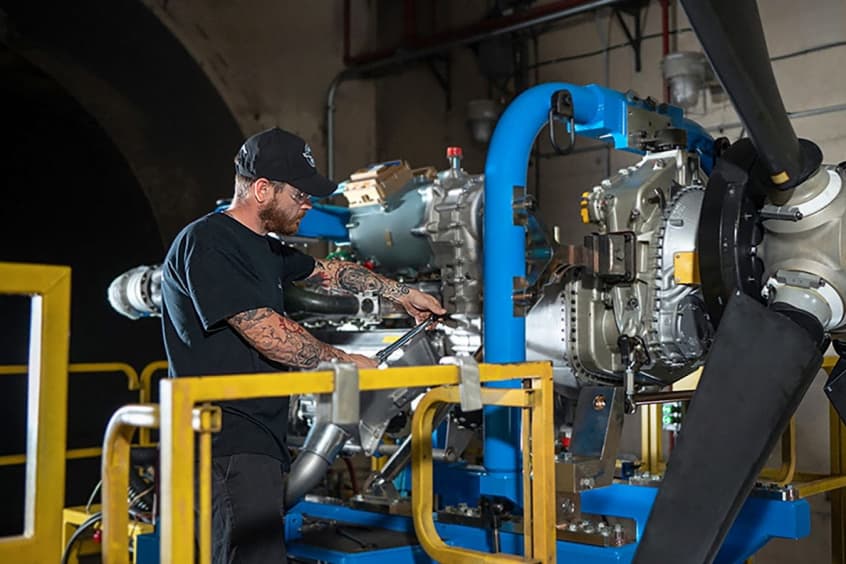
Pratt & Whitney Canada today announced a new phase in the RTX Hybrid-Electric Flight Demonstrator project, with ground testing of the flight-standard propulsion system and propeller in Longueuil, Quebec. Following completion of the ground test, the hybrid-electric propulsion system will be installed on the De Havilland Canada Dash 8-100 experimental aircraft, with the first flight expected in 2027. Pratt & Whitney is an RTX business.
"Assembling the final, flight-standard propulsion system brings us one step closer to proving hybrid-electric technology in flight," said Jean Thomassin, executive director, New Products and Services Introduction, Pratt & Whitney Canada. "We are advancing thermal engine and hybrid-electric technologies which could enhance fuel efficiency and performance for a wide range of future aircraft applications."
The hybrid-electric propulsion system combines an advanced Pratt & Whitney Canada thermal engine with a 1-megawatt electric motor and motor controller developed by RTX's Collins Aerospace, along with a battery system supplied by H55 S.A., a Swiss developer of certifiable aviation energy storage systems.
With the electric motor providing additional power during demanding flight phases such as takeoff and climb, the hybrid-electric architecture enables the propulsion system to operate more efficiently throughout the flight mission. The project aims to demonstrate up to 30% improved fuel efficiency for a typical 250-nautical-mile regional turboprop mission.
The RTX Hybrid-Electric Flight Demonstrator project has accelerated collaboration between leading aerospace industry companies and research institutions within Canada and abroad, including De Havilland Aircraft of Canada, GKN Aerospace, AeroTEC, Ricardo, the National Research Council of Canada and the Innovative Vehicle Institute.
The project is supported by the governments of Canada and Quebec. Additionally, the project's propulsion system verification phase is supported by Strix, the organisation managing Canada's Initiative for Sustainable Aviation Technology (INSAT), with funding from the Government of Canada, as part of its fifth wave of innovative research projects.