


Press release
17/11/2026
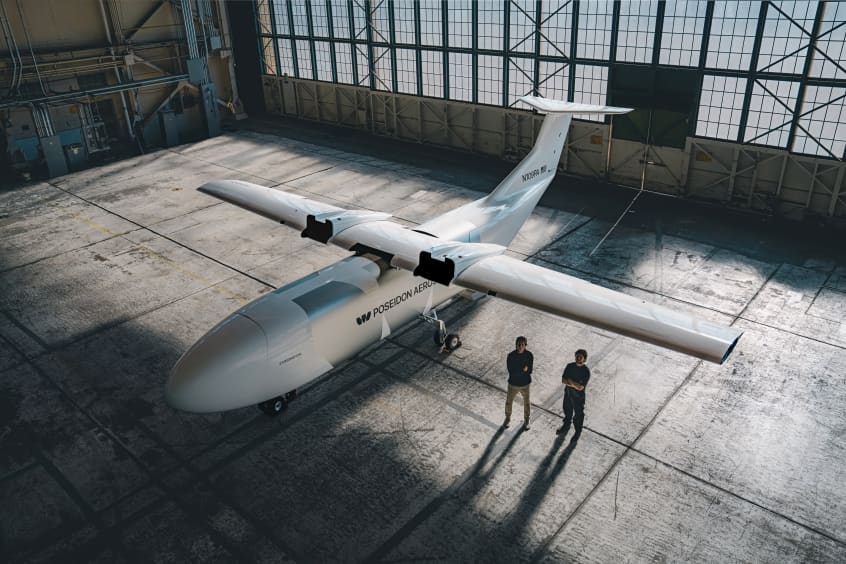
Flexcompute, the Frontier AI lab building a Physics World Model, today announced that Poseidon Aerospace is using its AI-powered geometry preparation and trusted simulation technology to predict and improve how its autonomous cargo aircraft will perform before flight. The work reduced aerodynamic database development from eight months to three weeks and enabled the engineering team to run 10× more simulations.
Regional air cargo has seen little innovation in decades. Aging aircraft, pilot shortages, and limited airport infrastructure make it difficult and expensive to deliver goods to remote, maritime, disaster-response, and infrastructure-limited regions. Poseidon Aerospace is addressing those challenges with autonomous, runway-independent cargo aircraft. Meeting those demands requires engineers to evaluate performance continuously as the aircraft design evolves.
To make that continuous evaluation possible, Poseidon is effectively building a Physics Twin of the aircraft. Together, GeometryAI and Flexcompute Flow (formerly Flow360) provide an early example of what Flexcompute calls a Physics Twin: a virtual representation of an evolving aircraft design grounded in established physics. While many aerospace digital-twin applications focus on monitoring an aircraft after it is built, a Physics Twin begins during design, helping engineers test tradeoffs and understand performance before hardware is produced or flight testing begins.
For Poseidon, that earlier access to trusted physics translated into measurable engineering gains. The team ran 10× more simulations, allowing engineers to evaluate more design configurations, ask better questions, and accelerate validation ahead of flight testing. Flexcompute Flow also gave the team a more accurate understanding of lift, drag, and flight dynamics, enabling faster tuning of mission-critical flight-control systems.
"With a small engineering team, we want AI to expand what our engineers can explore, not add complexity," said Rohan Sharma, PhD, VP of Engineering at Poseidon Aerospace. "GeometryAI gets our aircraft geometry ready for simulation, Flexcompute Flow gives us answers quickly, and our internal Python workflow with an AI agent connects the process end to end. The result is less time managing tools and more time engineering the aircraft, making design decisions, and closing trade studies."
Since adopting Flexcompute Flow, Poseidon has seen that advantage continue to grow. In a subsequent mission-critical design study, the team completed the work in 8.4 days, compared with an estimated 200 days using its prior workflow. That is nearly 25 times faster and represents more than six months of compute time saved.
"Regional air cargo is ripe for aircraft informed by bleeding-edge design techniques," said Vera Yang, President of Flexcompute. "We're removing computational bottlenecks, enabling innovators like Poseidon to ask better questions, explore more designs, and bring transformative aircraft to market demonstrably faster and safer."
Send releases and photographs to news@news.airframer.com — the pick of them reach Bulletin readers every Thursday.
The week’s aerospace manufacturing news, reported by our editors and delivered free to your inbox. Sign up ›
Subscribers see the confirmed supply chain behind every story — complete supplier lists for each aircraft program, sector and company. See the plans ›
Corrections go straight to the editorial team that maintains this directory.