
Press release
22/06/2023
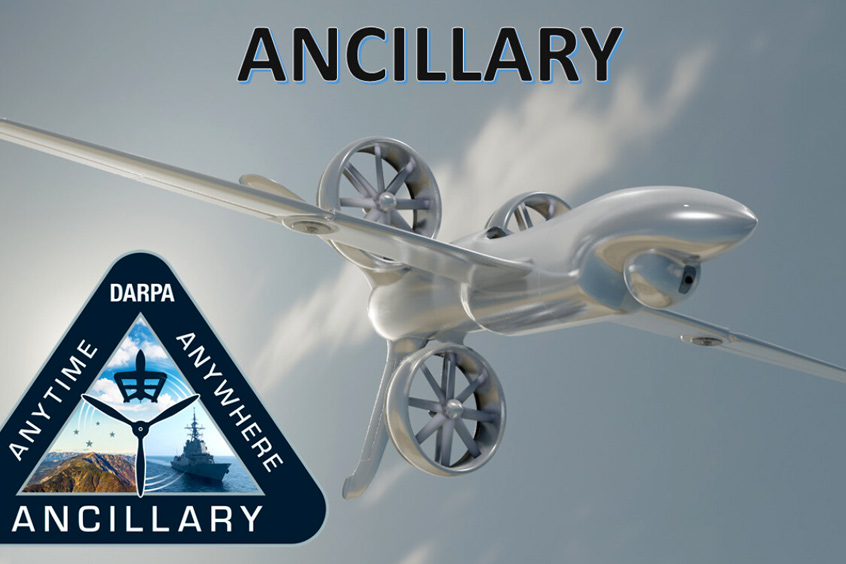
DARPA has selected nine companies to produce initial operational system and demonstration system conceptual designs for a vertical takeoff and landing (VTOL) uncrewed aerial system (UAS) that can be deployed and retrieved without the large mechanical launchers and landing/recovery equipment used today. The AdvaNced airCraft Infrastructure-Less Launch And RecoverY program, nicknamed ANCILLARY, ultimately plans to flight demonstrate innovative aircraft configurations and critical technologies needed for a low-weight, large-payload, long-endurance VTOL uncrewed X-plane.
AeroVironment, AVX Aircraft, Griffon Aerospace, Karem Aircraft, Leidos, Method Aeronautics, Northrop Grumman, Piasecki Aircraft, and Sikorsky will develop VTOL UAS designs, with Navy and Marine missions in mind, during the six-month Phase Ia. Teams then will submit competitive proposals for more detailed X-plane design work.
“The objectives of the program are to develop a small UAS that takes off and lands vertically, like a helicopter, and flies its mission like very efficient winged aircraft, while carrying a significant amount of payload for a variety of missions,” said Steve Komadina, the DARPA program manager for ANCILLARY. “We are looking for a VTOL UAS that can operate from ship flight decks and small out-of-the-way land locations in most weather conditions without using typical launch and recovery equipment that is needed for current long endurance, high payload weight aircraft.”
ANCILLARY aims to solve a combination of challenging design objectives by bringing together technology developments in advanced VTOL aircraft configurations, advanced propulsion architectures, and advanced control effectors/theory from traditional and non-traditional industry companies.
“The major challenge is developing an integrated flight vehicle that meets the hard objective of combining VTOL, long endurance, and large payload while also meeting requirements for shipboard storage and operations,” said Komadina. “A key element is the propulsion system, which needs to have enough power to lift the X-plane vertically while also being extremely efficient in forward flight when power needs are lower.”
The project is expected to culminate with X-plane flight tests in early 2026.
Send releases and photographs to news@news.airframer.com — the pick of them reach Bulletin readers every Thursday.
The week’s aerospace manufacturing news, reported by our editors and delivered free to your inbox. Sign up ›
Subscribers see the confirmed supply chain behind every story — complete supplier lists for each aircraft program, sector and company. See the plans ›
Corrections go straight to the editorial team that maintains this directory.