
Press release
30/11/2021
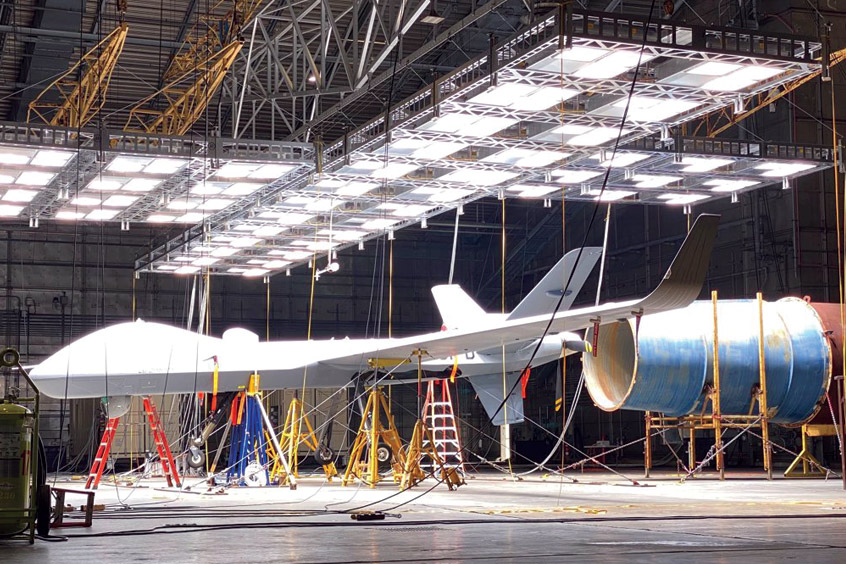
General Atomics Aeronautical Systems Inc. (GA-ASI) has successfully completed key system-level tests for the new Protector RG Mk1 Remotely Piloted Aircraft (RPA). The Protector is the UK Royal Air Force's version of the MQ-9B SkyGuardian, which is GA-ASI's latest model of RPA and is on track to become the world's first certified Medium-altitude, Long-endurance (MALE) RPA. The first Protector is expected to complete its test and evaluation program late 2022 and arrive in the UK in 2023.
The recently completed tests include Full-Scale Static Strength, High-Intensity Radiated Frequency (HIRF) and Environmental Testing. Most of the tests were performed by GA-ASI using internal research and development funding with the Royal Air Force (RAF) and U.S. Air Force supporting key elements of the HIRF testing.
"It's exciting to see the progress of the Protector Programme," said RAF Group Captain Shaun Gee, Director Air ISTAR Programmes (RPAS and TacISR), and SRO Shadow Programme. "GA-ASI has provided support, not only in the testing of the aircraft, but in developing this game-changing RPA platform. GA-ASI provided a company MQ-9B over this past summer and operated it from RAF bases in the UK to help us get acquainted with its operational capabilities ahead of the first delivery of Protector."
The Full-Scale Static (FSS) test included multiple stress tests where the full fuselage, wings, tails and landing gear were tested to 150% of the highest operational loads. FSS tests the strength of all the major structures in the aircraft, verifying its safety and reliability when operated at maximum airspeeds and G-loads. This is key to demonstrating the aircraft's airworthiness, which will enable Protector to fly in all classes of UK and international airspace.
Environmental Testing took place at the McKinley Climatic Laboratory at Eglin Air Force Base and featured a variety of tests, such as extreme cold temperature (to -33 degrees Celsius), in-flight ice, supercooled fog, in-flight rain, high humidity, and high temperature with solar load.
High-Intensity Radiated Frequency testing occurred at the Electromagnetic Environmental Effects (E3) Test Facility at the Naval Air Station Patuxent River where the system was subjected to high-intensity electromagnetic radiation across the full operational electromagnetic spectrum. The test program also included the Hazards of Electromagnetic Radiation on Ordnance (HERO) testing for the Protector weapons load-out.
"These critical system-level tests prove the safety and reliability of our aircraft to operate in extreme climates and electromagnetic environments," said Chris Dusseault, Senior Director for the Protector RPAS at GA-ASI. "We're proud to see the design concepts of MQ-9B be proven in operational environments bringing the Protector system one step closer to fielding with our RAF partner."
Send releases and photographs to news@news.airframer.com — the pick of them reach Bulletin readers every Thursday.
The week’s aerospace manufacturing news, reported by our editors and delivered free to your inbox. Sign up ›
Subscribers see the confirmed supply chain behind every story — complete supplier lists for each aircraft program, sector and company. See the plans ›
Corrections go straight to the editorial team that maintains this directory.