
Press release
31/07/2026

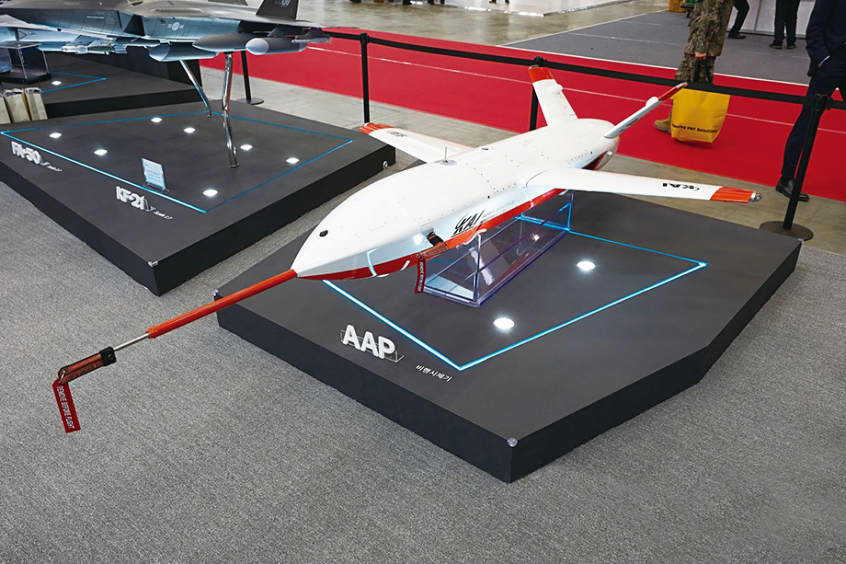
On the 30th, KAI (Korea Aerospace Industries) was selected as the preferred bidder for the defence sector of the "K-On-Device AI Semiconductor Technology Development Project," an initiative led by the Ministry of Trade, Industry and Energy.
This project, valued at a total of 95.3 billion KRW, aims to develop on-device AI semiconductors and integrate/verify them within unmanned aerial vehicle (UAV) platforms over a five-year period.
KAI will collaborate with AI semiconductor partners to develop an AI semiconductor (System on Chip, or SoC) for defence applications and an Autonomous Control System (ACS), an on-device computer incorporating this chip. The company will then integrate and verify the system on the UAV platforms it is currently developing in-house.
The project consists of three specific sub-tasks. KAI will oversee the overall project and lead Sub-tasks 1 and 3, taking responsibility for the development, integration, and verification of high-speed expendable aerial UAVs and the ACS. Sub-task 2, which involves the development of the AI semiconductor itself, will be led by a domestic fabless (semiconductor design) company.
A consortium of top-tier domestic SMEs and institutions specialising in AI semiconductors and AI models will join forces for the project, while Samsung Electronics will handle semiconductor production (foundry services) to ensure the highest level of reliability.
This project is expected to serve as a prime example of mutually beneficial cooperation; it will achieve the localisation and self-reliance of defence semiconductors, an area previously heavily dependent on overseas sources, while simultaneously opening up high-value new markets for capable domestic SME fabless and AI companies.
A KAI official stated, "The global community is accelerating the move toward autonomous weapon systems. Securing indigenous defense AI technology is essential for national survival." The official added, "As this project marks the first instance of applying a domestically developed AI semiconductor to an actual defense platform, it will serve as a pivotal moment in securing both AI sovereignty and defense sovereignty."
KAI plans to fully launch its "Physical AI" capabilities in the aerospace defence sector by integrating these domestic AI semiconductors into "AI Pilot" (KAI-lot), a system currently under in-house development, and to expand its "Sovereign AI" footprint into AI semiconductors designed for space satellites.
For the AI Pilot to autonomously control unmanned aerial vehicles (UAVs), it must analyse vast amounts of data and make decisions in real time; AI semiconductors are the critical component enabling this process.
In particular, KAI intends to extend the scope to AI semiconductors for satellites, aiming to secure a leading position in next-generation space intelligence technology. This involves using on-device AI within the satellite to immediately process and analyse massive battlefield datasets acquired by reconnaissance satellites, eliminating the need for ground control intervention.
Through this initiative, KAI envisions the phased completion of a fully "Hyper-Connected Battlespace" architecture that integrates air (manned and unmanned aircraft), space (satellites), and ground assets using its proprietary AI semiconductors and communication networks.
Meanwhile, KAI is laying the groundwork to develop a "Sovereign AI" framework that bridges hyperscale AI and cloud technologies with cutting-edge on-device AI semiconductors; the company signed memoranda of understanding (MOUs) with Samsung Electronics last November and with "Team Naver" (Naver and Naver Cloud) earlier this month.
Send releases and photographs to news@news.airframer.com — the pick of them reach Bulletin readers every Thursday.
The week’s aerospace manufacturing news, reported by our editors and delivered free to your inbox. Sign up ›
Subscribers see the confirmed supply chain behind every story — complete supplier lists for each aircraft program, sector and company. See the plans ›
Corrections go straight to the editorial team that maintains this directory.