
Press release
15/09/2026
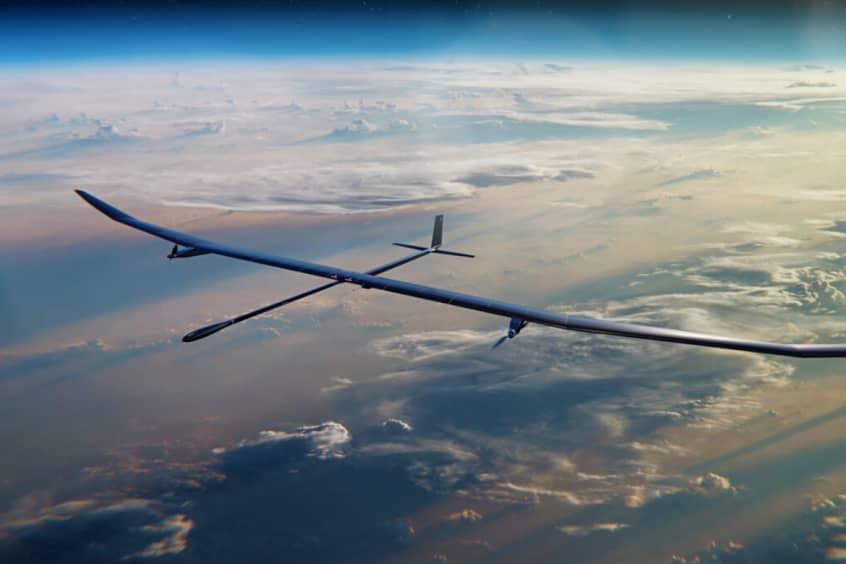
A UK designed and built solar powered stratospheric aircraft has been selected to support the UK's Advanced Research + Invention Agency (ARIA) Enduring Atmospheric Platforms programme to develop low cost, long endurance platforms for high-altitude communications.
Under the new £15.7m contract Prismatic, the BAE Systems company which has developed the PHASA-35 High Altitude Pseudo Satellite (HAPS) Uncrewed Air System (UAS), will provide the aircraft as the flight demonstration platform for a new power beaming technology designed to keep solar-powered stratospheric aircraft flying year-round, day or night.
This technology could be transformative as solar powered HAPS like PHASA-35 currently rely on the sun to sustain flight. That becomes a significant challenge in places like the UK, where winter daylight is limited and the nights are long. Power beaming removes that dependency, providing a constant supply of power regardless of the season and making it easier to continuously fly for up to several months at a time.
"PHASA-35 has already proven its worth in the stratosphere as a low-cost alternative to satellites and now this exciting project will explore whether we can make it even more capable.
"This is a strong example of British organisations working together to advance an emerging technology."
Bob Davidson
CEO BAE Systems' Prismatic
"This research expands the UK's leadership in high-altitude platforms to become the place where this industry is designed, built and scaled.
"Getting there means backing bold ideas, from fixed-wing solar aircraft to designs nobody predicted, including aircraft that fly on spinning wings instead of propellers."
Rico Chandra
Programme Director for Enduring Atmospheric Platforms at ARIA
With a 35-metre wingspan and a weight of just 150kg, PHASA-35 has the potential to operate above 66,000ft in the stratosphere for months at a time, operating continuously to deliver persistent communications, Earth observation and surveillance at a fraction of the cost of traditional satellites, and with far greater flexibility to deploy and upgrade.
The new system uses a highly controlled ground-based energy beam directed at a dedicated receiver, built into the aircraft's wing, which converts it back into electricity to power the aircraft and charge its batteries. Similar microwave frequencies are already widely used in aviation, satellite communications and radar systems.
For PHASA-35, the benefits potentially extend beyond persistent flight. Reducing the weight of onboard battery arrays could free up additional capacity on the aircraft with an already class-leading payload of up to 15kg. That payload can be used flexibly to carry a wide range of sensors across intelligence, surveillance and reconnaissance, communications, Earth observation and defence applications.
The three-stage, 3.5-year programme will conclude with an integrated flight demonstration with PHASA-35 to prove the power beaming solution that could open further potential for stratospheric flight.
Where we hold a LinkedIn profile it’s marked — the links come with a subscription.
Send releases and photographs to news@news.airframer.com — the pick of them reach Bulletin readers every Thursday.
The week’s aerospace manufacturing news, reported by our editors and delivered free to your inbox. Sign up ›
Subscribers see the confirmed supply chain behind every story — complete supplier lists for each aircraft program, sector and company. See the plans ›
Corrections go straight to the editorial team that maintains this directory.