
Airframer news
15/01/2026
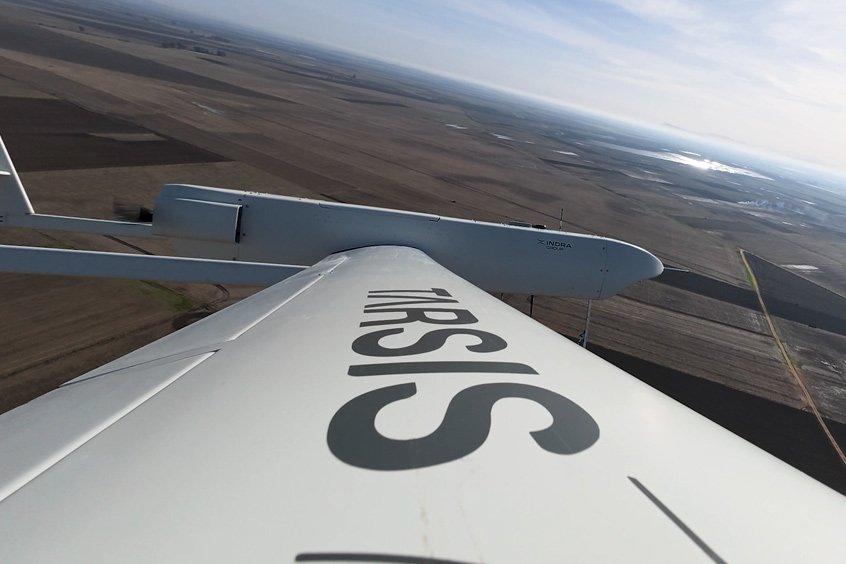
Real-world tests in Seville confirmed that the system’s fusion of radar and visual data could identify aircraft at distance and respond in real time.
Indra has demonstrated the effectiveness of its new UAV collision detection and avoidance system with a series of test flights completed at the Aerohíspalis airfield in Seville.
Developed under the strategic programme of the Galician Aerospace Hub, in partnership with Tecnobit-Grupo Oesía, the technology integrates 360 degree onboard cameras and electronically steered radar to detect aircraft in shared airspace and trigger real-time avoidance manoeuvres.
The system was validated on a multirotor UAV that successfully tracked and responded to the presence of an Indra TARSIS-family drone at distances of up to one kilometre. Test conditions replicated a range of typical UTM (Unmanned Traffic Management) scenarios, including different trajectories, altitudes and speeds up to 2,000 metres.
The system's onboard processors support advanced algorithms that enhance decision-making and ensure reliability in complex operations such as drone swarms or mixed manned-unmanned environments.
Indra and Tecnobit-Grupo Oesía are also collaborating on UAV platforms for search and rescue, maritime spill detection and firefighting. Their VTOL-type drones, featuring hybrid propulsion and 20kg payload capacity, aim to meet growing demand for medium-sized systems with extended endurance and flexibility.
Where we hold a LinkedIn profile it’s marked — the links come with a subscription.
The week’s aerospace manufacturing news, reported by our editors and delivered free to your inbox. Sign up ›
Subscribers see the confirmed supply chain behind every story — complete supplier lists for each aircraft program, sector and company. See the plans ›
Corrections go straight to the editorial team that maintains this directory.