
Airframer news
20/04/2023
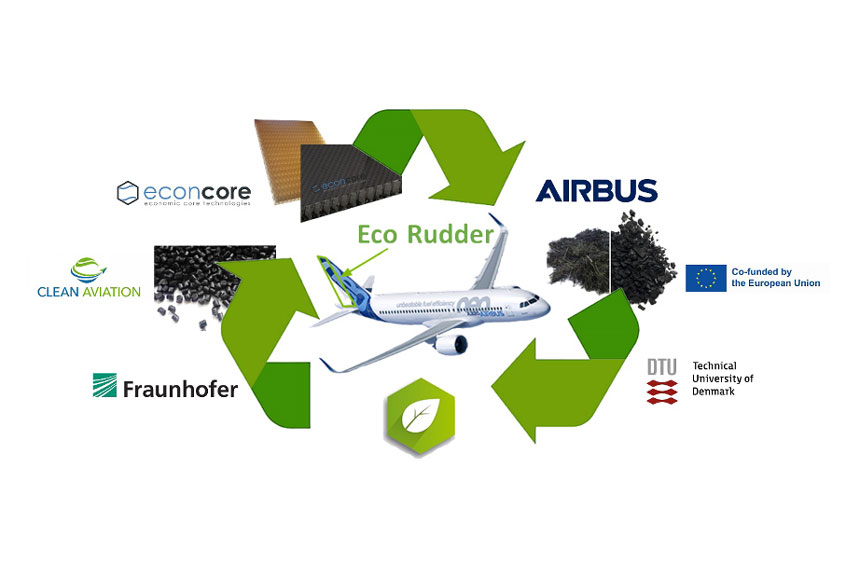
Four partners will collaborate on the work package in FASTER H2, called EcoRudder, which focuses on the development of a new generation rudder structure for a single-aisle commercial aircraft.
Airbus, Fraunhofer, DTU and the sandwich core supplier EconCore are to develop a new generation green and sustainable rudder structure based on potentially recyclable thermoplastic materials. It forms part of the project "FASTER H2", funded by the European Union's Clean Aviation Research Program under Horizon Europe and led by Airbus. The four partners will collaborate on the work package in FASTER H2, called EcoRudder, which focuses on the development of a new generation rudder structure for a single-aisle commercial aircraft. It is envisaged that the rudder structure will be redesigned and replaced with thermoplastic materials that have the potential to be recycled after the aircraft has been decommissioned.
Within the scope of the project, thermoplastic honeycomb sandwich structures will be produced and evaluated against the requirements for the rudder, and a recycling concept for the panels will be demonstrated. Beside the extensive testing and analysis to ensure that the materials meet all requirements for a certification in a structural aircraft component, also a detailed life-cycle analysis (LCA) will be performed to confirm the reduced CO2 footprint of the new thermoplastic honeycomb sandwich rudder.
Composite sandwich construction has proven to be a very efficient structural concept in structural aircraft parts. In line with today’s sustainability requirements, green composites are expected to replace conventional thermoset materials such as phenolic resin honeycombs and epoxy laminates. This improvement in sustainability has to be achieved without compromising on mechanical requirements such as damage tolerance under extreme environments and unintended loading scenarios. Sufficient robustness and structural integrity against service loads, as well as potentially recycling of the thermoplastic constituent materials, must also be ensured.
The week’s aerospace manufacturing news, reported by our editors and delivered free to your inbox. Sign up ›
Subscribers see the confirmed supply chain behind every story — complete supplier lists for each aircraft program, sector and company. See the plans ›
Corrections go straight to the editorial team that maintains this directory.