
Airframer news
24/09/2026
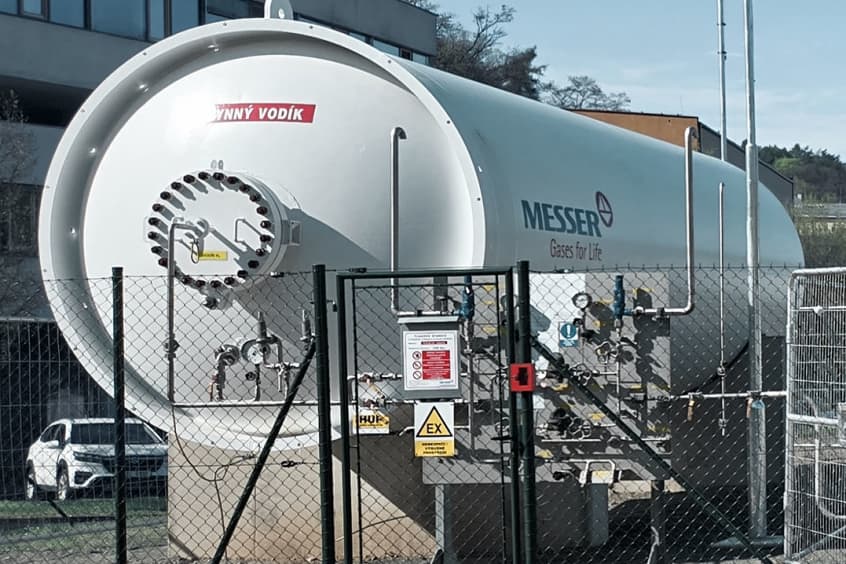
An EU-funded consortium of 18 companies from 10 countries has integrated a hydrogen power source capable of generating and supplying electrical energy for a Honeywell aircraft.
Honeywell Aerospace's Brno engineering team and its consortium partners have integrated the individual subsystems of Project NEWBORN into a functional hydrogen power source capable of generating and supplying electrical energy for an aircraft.
Funded by the European Union through the EU Clean Aviation Joint Undertaking, Project NEWBORN launched in 2023 and brings together a consortium of 18 companies from 10 European countries. It aims to develop an aerospace-qualified, megawatt-class hydrogen fuel-cell propulsion system. The next step will be an integrated ground demonstration of the complete propulsion system, in which the hydrogen power source and batteries will supply electricity to an electric motor driving an aircraft propeller.
To test the power source, Honeywell Aerospace developed a dedicated platform that can simulate a range of functions of an actual aircraft. Installed at the research and engineering facility operated by ÚJV Řež near Prague, the platform includes its own power source, working fluid distribution systems, electrical systems, a control room, safety equipment and heat rejection systems.
The engineering team integrated the fuel cells with other subsystems and verified the functionality of the entire electrical power source. Tests also examined system leak tightness, operating parameters of the working fluids, interaction between the individual subsystems, control algorithms and protection mechanisms. Further testing will focus on expanding the power range and increasing the stability and resilience of the hydrogen power source.
Development has taken place in parallel at several levels. PowerCell, Fraunhofer and Test-Fuchs contributed to individual parts of the electrical power source and related technologies, while Siemens Industry Software, KU Leuven, Friedrich-Alexander-Universität Erlangen-Nürnberg and CIRA worked on modelling, simulations and integration studies to identify technical risks and validate design concepts.
Miroslav Matoušek, NEWBORN project coordinator, Honeywell Aerospace, says: “Project NEWBORN is not only demonstrating new technology, it is demonstrating the ability of European industry, universities and research organisations to work together on ambitious technological visions and turn them into functioning systems.”
Ondřej Kotaba, technology fellow and NEWBORN technical lead with Honeywell Aerospace, adds: “Bringing all these subsystems together into a single functional unit will represent the culmination of the project.”
The hydrogen power source will be transferred to Gorizia, Italy, for the continuation of the project. Final tests there will connect the fuel-cell power source to battery systems from Pipistrel and a megawatt-class electric propulsion system jointly developed by the University of Nottingham, Honeywell Aerospace and Pipistrel. The resulting demonstrator is expected to be one of the world’s most powerful hydrogen-electric aircraft propulsion systems of its kind.
The week’s aerospace manufacturing news, reported by our editors and delivered free to your inbox. Sign up ›
Subscribers see the confirmed supply chain behind every story — complete supplier lists for each aircraft program, sector and company. See the plans ›
Corrections go straight to the editorial team that maintains this directory.