
Airframer news
26/06/2025
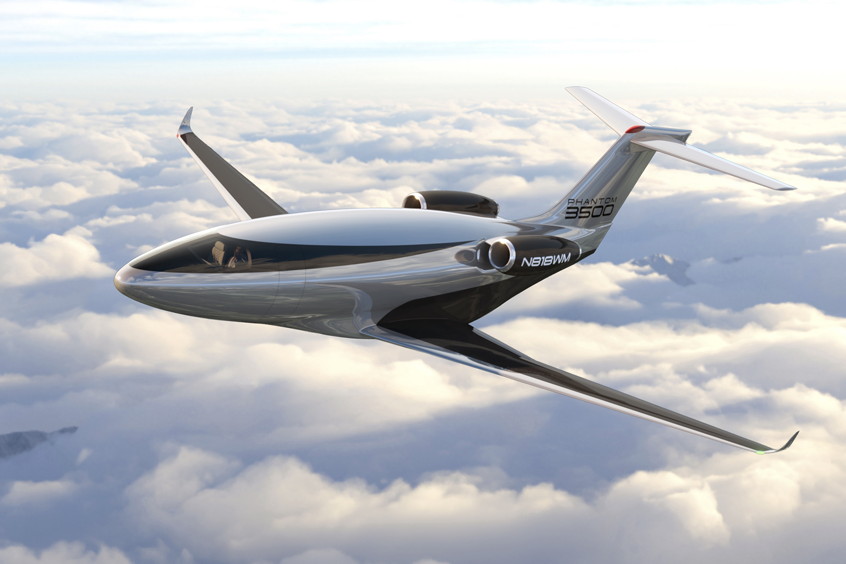
As progress on its next-generation aircraft accelerates, the company named its engine, avionics and tooling partners and outlined plans to build and certify the jet by 2030.
Otto Aviation used its Paris Air Show briefing to detail progress on its Phantom 3500 programme, including the selection of major systems and suppliers, facility plans and performance ambitions. The aircraft is expected to reach net-zero carbon emissions by 2030, twenty years ahead of the broader aviation industry’s 2050 target.
CEO Paul Touw described the Phantom 3500 as “the first true aircraft of the sustainability era”, citing its 60 per cent fuel burn reduction compared to similar-sized jets and 90 per cent emissions cut when using sustainable aviation fuel. The aircraft features a transonic super-laminar flow design with AI-supported aerodynamics, and offers seating for nine with a 6'5" cabin height. Instead of windows, it uses HD display panels known as Super Natural Vision.
Otto will build the aircraft at Cecil Airport in Jacksonville, Florida, investing $430 million and relocating its headquarters to the site. Initial flight tests are planned for early 2027, with certification and service entry expected by 2030.
To power the aircraft, Otto has selected Williams International’s FJ44-4 QPM engine. The engine supports 100 per cent sustainable aviation fuel and integrates auxiliary power unit functionality. Otto Aviation COO Scott Drennan says, “The FJ44-4 QPM aligns perfectly with the Phantom 3500’s mission. Its combination of fuel efficiency, thrust performance and sustainable design will enable us to deliver on our promise of long-range capability with dramatically reduced environmental impact.”
For avionics, Otto has chosen the Garmin G700 TXi system for the initial flight test vehicle. The suite supports real-time telemetry, modular integration and tailored display interfaces for test environments. Drennan adds, “Flight testing is a pivotal phase in any aircraft program, and the G700 TXi gives us the precision, flexibility and situational awareness we need.”
The company also named Advanced Integration Technology (AIT) as its tooling and automation partner for the production system. AIT will provide assembly and joining systems, metrology tools and scalable automation cells. Otto’s director of manufacturing Steven Afalla says, “AIT’s systems and expertise give us the precision, reliability and scalability we need to bring the Phantom 3500 to life.”
The Phantom 3500 is designed to cruise at over 600 mph and fly up to 3,500 nautical miles at altitudes of 51,000 feet. Operating costs are expected to be half those of average super-midsize jets.
Where we hold a LinkedIn profile it’s marked — the links come with a subscription.
The week’s aerospace manufacturing news, reported by our editors and delivered free to your inbox. Sign up ›
Subscribers see the confirmed supply chain behind every story — complete supplier lists for each aircraft program, sector and company. See the plans ›
Corrections go straight to the editorial team that maintains this directory.