
Airframer news
05/11/2026
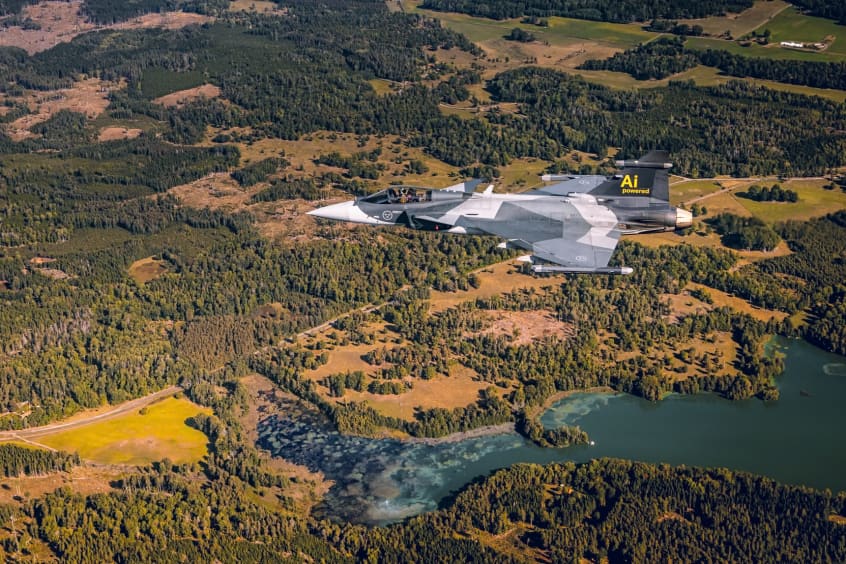
Developed, trained and flown entirely within Saab, the AI agents have autonomously controlled Gripen E in Beyond Visual Range combat scenarios during flight trials.
Saab has flown its own in-house artificial intelligence (AI) agents on Gripen E, demonstrating its ability to develop, train and fly its own AI for air combat all the way from concept to an operational fighter aircraft.
During the flight trials, the agent autonomously controlled the aircraft in Beyond Visual Range (BVR) combat scenarios. Gripen E’s software-defined architecture enables AI software to be integrated and flown in an operational fighter aircraft without the need for dedicated experimental platforms, shortening development cycles.
Developed within Saab’s Advanced Programmes business unit, the family of agents uses various AI techniques to master tactical decision-making in complex operational environments. The agents can support the pilot in the cockpit or operate alongside pilots in their own unmanned air platform. The agents, training environments and supporting development tools have all been developed within Saab, providing full control over how the agents operate, how they are verified and how they continue to evolve.
Peter Nilsson, head of Advanced Programmes at Saab’s business area Aeronautics, says: “We have not only built our own AI agents, but we have also flown them. This demonstrates our capability to develop AI agents that can be integrated into operational fighter aircraft.”
He adds: “The future of air combat will not be defined by individual platforms acting alone, but by networks of crewed and uncrewed systems working together as a coordinated force.”
The agents are developed through Saab’s AI Fighter Pilot Academy, which also builds the infrastructure required to create, train and evaluate AI agents across a wide range of scenarios and platforms. Agents are trained in simulated environments across multiple air combat capabilities. By accumulating millions of simulated flight hours, they can explore tactics and decision paths far beyond what any individual pilot could experience in a lifetime. BVR air combat is one such capability and has been validated under real flight conditions. The infrastructure has been designed for reuse, so capabilities, scenarios and platforms can be added without rebuilding the development framework. Safety and control are integrated into the development process from the outset rather than added afterwards.
Supporting Saab’s ability to scale this work is Sferical AI, a Swedish sovereign AI initiative providing secure, large-scale computing capacity for advanced AI development. Saab is a founding partner in the initiative.
Saab is continuing to expand the capabilities of its agents and to fly them in a broader range of scenarios. The infrastructure developed within the AI Fighter Pilot Academy provides an important foundation for unmanned platforms.
Where we hold a LinkedIn profile it’s marked — the links come with a subscription.
The week’s aerospace manufacturing news, reported by our editors and delivered free to your inbox. Sign up ›
Subscribers see the confirmed supply chain behind every story — complete supplier lists for each aircraft program, sector and company. See the plans ›
Corrections go straight to the editorial team that maintains this directory.