
Press release
20/07/2022

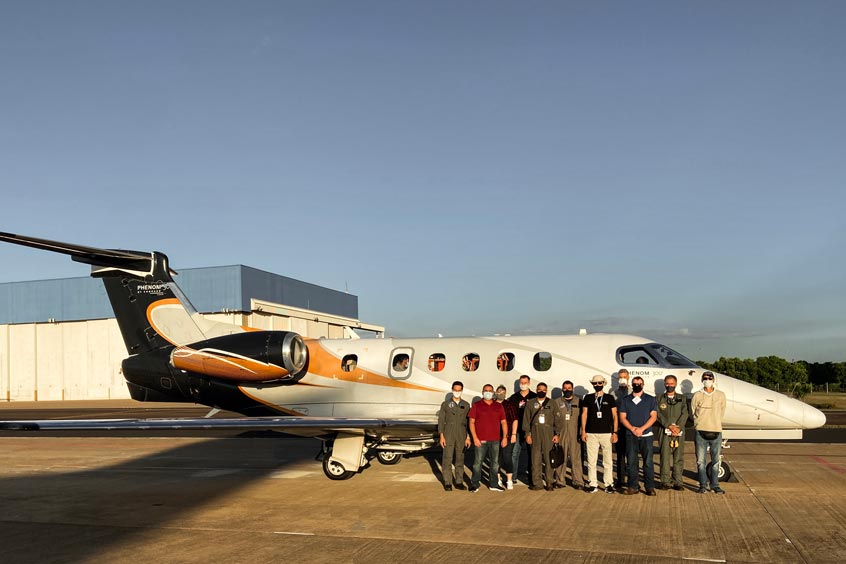
Embraer and Collins Aerospace are collaborating on the development and testing of an innovative carbon nanotube electro thermal heating technology (CNT) for ice protection systems that seeks to result in more efficient and sustainable aircraft. The project recently achieved a major milestone by initiating a flight test campaign at Embraer's Gavião Peixoto unit in Brazil.
The new CNT ice protection system solution was successfully installed on the vertical stabilizer and flight tested in Embraer's fully functional Phenom 300E prototype, the world's best-selling light jet for 10 consecutive years. Collins' CNT heater and ice protection controller were integrated into the prototype aircraft before executing over 10 hours of ground and “dry air” flight tests. The first flight in December 2021 ran successfully, smoothly, and flawlessly, demonstrating the seamless integration of the CNT heater technology ice protection system.
“We are very encouraged by the recent test results, and we are convinced that this innovative technology will meet our ambitious technological and sustainability roadmap,” said Luís Carlos Affonso, Senior Vice President Engineering, Technology Development and Corporate Strategy at Embraer. “We are glad to have Collins on this journey to explore further partnership opportunities that will help create a net zero carbon aviation industry”.
“This electrothermal CNT technology is more energy efficient, lighter and uses greener manufacturing processes than current systems, and we believe it will become the future standard for ice protection – including those in more electric aircraft designs,” said Dr. Mauro Atalla, senior vice president, Engineering and Technology for Collins Aerospace. “Collaborations such as the one between Collins and Embraer are helping innovations like this come to market more quickly.”
The evaluation of flight condition was possible after the conclusion of parameters evaluation, structural, electromagnetic compatibility, and over 500 hours in the icing tunnel, among other tests that made steady progress in recent years. The technological and research activities aim to further increase the technology readiness level by conducting additional ground tests and flying in natural icing conditions. The project is part of the More Electric Aircraft (MEA) technologies development approach, which includes a series of industry initiatives to ensure the commitment to net-zero emission by 2050.
Heaters based on CNT technology present significant advantages when compared to existing metallic heaters. The major benefits include eliminating the chemical etching process, lowering the energy requirement by 25 percent at system level, and minimizing aerodynamic adverse effects caused by ice. The CNT's lightweight heater element is significantly lighter than a conventional metallic heater, features enhanced damage tolerance, and should result in a longer product life cycle.
Send releases and photographs to news@news.airframer.com — the pick of them reach Bulletin readers every Thursday.
The week’s aerospace manufacturing news, reported by our editors and delivered free to your inbox. Sign up ›
Subscribers see the confirmed supply chain behind every story — complete supplier lists for each aircraft program, sector and company. See the plans ›
Corrections go straight to the editorial team that maintains this directory.