


Airframer news
20/05/2021
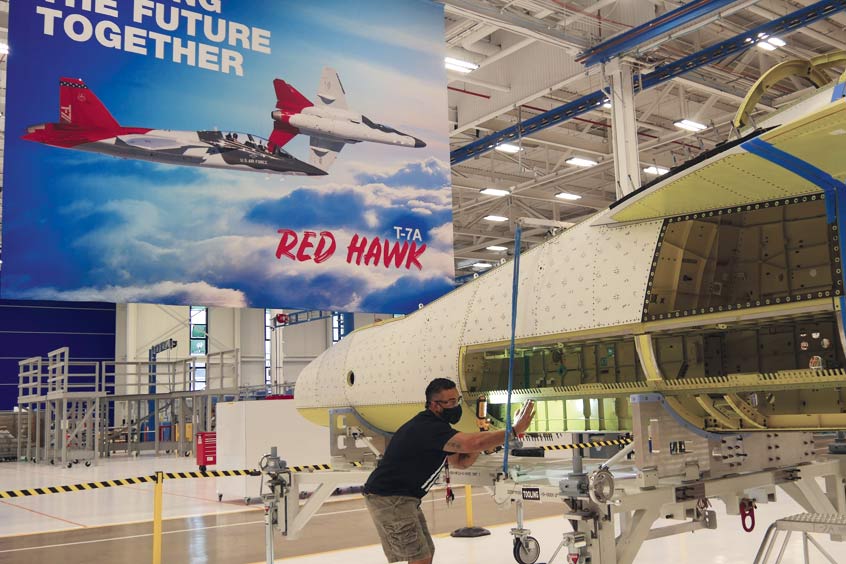
It took just half an hour to join the front and aft sections of the T-7A trainer, with a 98% reduction in drilling defects. The latest digital techniques are delivering an improvement of 50% in production quality.
The front fuselage of the first Boeing-Saab T-7A Red Hawk advanced trainer has been joined perfectly with its aft section in less than 30 minutes. The achievement is a result of the digital heritage of the U.S. Air Force's first "eSeries" aircraft and witness to the benefits of model-based engineering and 3D design.
The digital splice was completed in 95% less time than traditional splices and with substantial quality improvements.
"This moment marks a key stage in the evolution of the T-7A Red Hawk," says Chuck Dabundo, vice president and program manager of Boeing T-7 programs. "Employing digitally advanced manufacturing and build techniques developed by Boeing over the past two decades, we are bringing this trainer to future pilots sooner than ever before possible and with greater quality."
The aft fuselage was designed and built by Saab in Linkoping, Sweden, under a joint development agreement with Boeing. After making the journey of more than 4,500 miles (7,200 kilometres) to St. Louis, the aft section was lined up perfectly to the forward fuselage by Boeing aircraft mechanics.
The aircraft, which will be used for static test, is the first engineering and manufacturing development test asset to be spliced. It will be followed by five engineering and manufacturing development jets as part of 351 T-7A Red Hawk trainers to be produced for the U.S. Air Force.
"What we're seeing in this new evolution of digitally designed, engineered and manufactured aircraft is a 50% improvement in overall production quality and as much as a 98% reduction in drilling defects," says Andrew Stark, Boeing T-7A Red Hawk production director. "It's a new way of producing airplanes with improved quality throughout the whole journey."