
Airframer news
02/09/2026
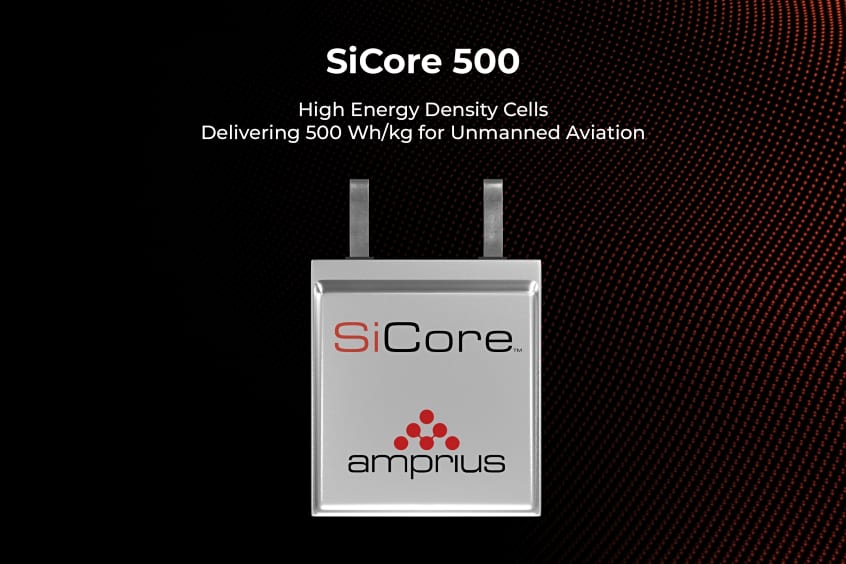
The second-generation SiCore cell reaches 500 Wh/kg on standard manufacturing equipment, opening a route to volume production for long-endurance aviation platforms.
Amprius Technologies has developed a second-generation SiCore battery cell delivering 500 Wh/kg at a 1C continuous discharge rate, aimed at long-endurance aviation applications including high-altitude platform stations (HAPS) and fixed-wing drones.
Unlike earlier cells that reached similar energy density, this generation can be produced on conventional lithium-ion manufacturing equipment already installed across Amprius’ contract manufacturing network. That removes the specialised materials handling and non-standard cell construction previously required to hit 500 Wh/kg, giving customers a path from qualification to volume without additional tooling.
In HAPS operation, stored energy and battery weight determine whether persistent stratospheric flight is achievable. Fixed-wing platforms bank daytime solar energy to sustain overnight flight, while lighter-than-air designs draw on it for propulsion and station keeping. Higher specific energy can extend flight duration, range and payload without adding weight.
Amprius has supplied cells for AALTO’s Zephyr HAPS programme since 2018, across several generations of the aircraft, including a 2025 flight that reportedly set a 67-day world endurance record. Pierre-Antoine Aubourg, COO at AALTO HAPS, says: “Energy density is fundamental to Zephyr’s endurance. Our longstanding relationship with Amprius has focused on advancing the energy storage required for persistent stratospheric flight. Continued gains in specific energy can meaningfully extend flight duration and expand mission capability.”
Dr Ionel Stefan, CTO of Amprius Technologies, adds: “Reaching 500 Wh/kg is a significant technical milestone, but how we reached it matters as much as the number. By achieving that performance level on conventional manufacturing equipment, our aviation customers can qualify this cell knowing that we have designed a cost-effective, scalable path to volume behind it.”
Amprius expects commercial availability of the second-generation SiCore cell in the fourth quarter of 2026, in customer-specific formats and in the standard small uncrewed aircraft systems (sUAS) pouch format defined by SAE JA1016. Initial production is planned at the company’s Fremont, California facility, with volume output scaled through Amprius’ existing global contract manufacturing partners.
The week’s aerospace manufacturing news, reported by our editors and delivered free to your inbox. Sign up ›
Subscribers see the confirmed supply chain behind every story — complete supplier lists for each aircraft program, sector and company. See the plans ›
Corrections go straight to the editorial team that maintains this directory.