
Airframer news
21/10/2021
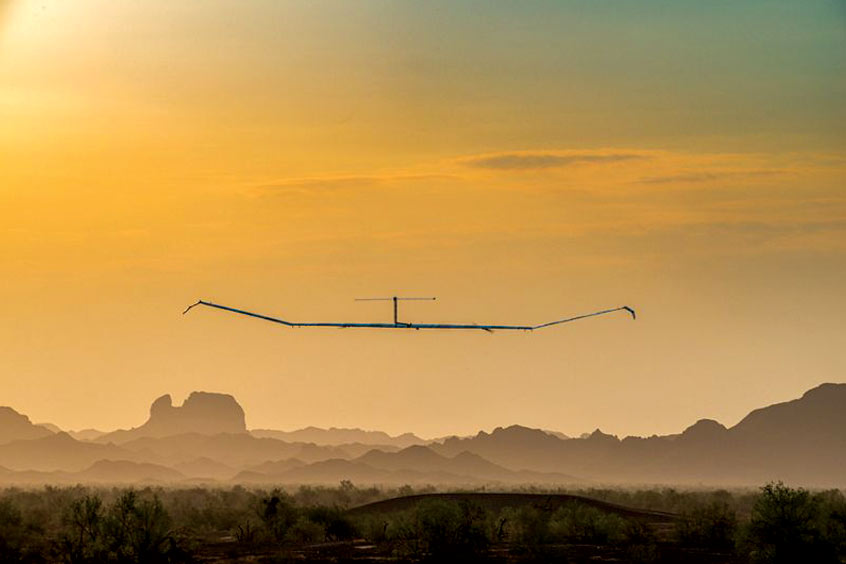
Airbus’ solar-powered Zephyr could revolutionise disaster management. It uses sunlight to fly and recharge its batteries so can stay airborne for months at a time.
The Airbus Zephyr S has completed its 2021 US test flight campaign after the final solar-powered High Altitude Platform System (HAPS) flight touched down on 13 September in Arizona. The campaign focus was to demonstrate how Zephyr S could be used for future operations, flying outside of restricted airspace and over airspace shared with commercial air traffic. Carrying an Optical Advanced Earth Observation system for Zephyr (OPAZ) payload, the aircraft proved its operational value to provide instant, persistent and improved situational awareness.
The Zephyr S uses sunlight to fly and recharge its batteries, using no fuel and producing no carbon emissions. With its ability to remain in the stratosphere for months at a time, it will bring new ‘see, sense and connect’ capabilities to both commercial and military customers. As such it has the potential to revolutionise disaster management, including monitoring the spread of wildfires or oil spills. It provides persistent surveillance, tracing the world's changing environmental landscape, and will be able to provide communications to the most unconnected parts of the world.
The campaign consisted of four low level test flights and two stratospheric flights, the latter flying for around 18 days each. This adds a further 887 flight hours to the 2,435 stratospheric flight hours for Zephyr to date. It also marks significant progress for fixed wing HAPS and is a step towards making the stratosphere an operational reality for its customers.
"Credible and proven ultra-persistence, stratospheric agility and payload interoperability underscore why Zephyr is the leader in its sector,” says Airbus head of unmanned aerial systems Jana Rosenmann. “It is a sustainable, solar powered, ISR and network extending solution that can provide vital future connectivity and earth observation to where it is needed.”
The week’s aerospace manufacturing news, reported by our editors and delivered free to your inbox. Sign up ›
Subscribers see the confirmed supply chain behind every story — complete supplier lists for each aircraft program, sector and company. See the plans ›
Corrections go straight to the editorial team that maintains this directory.