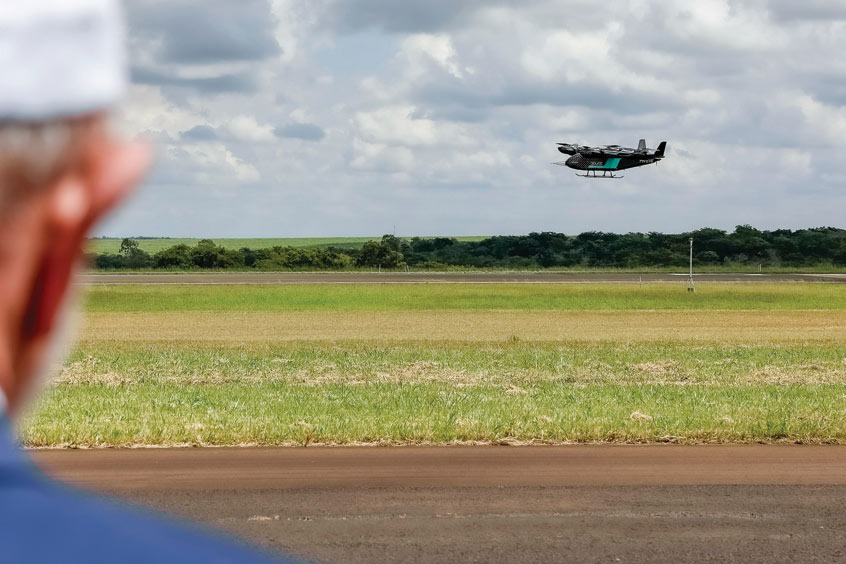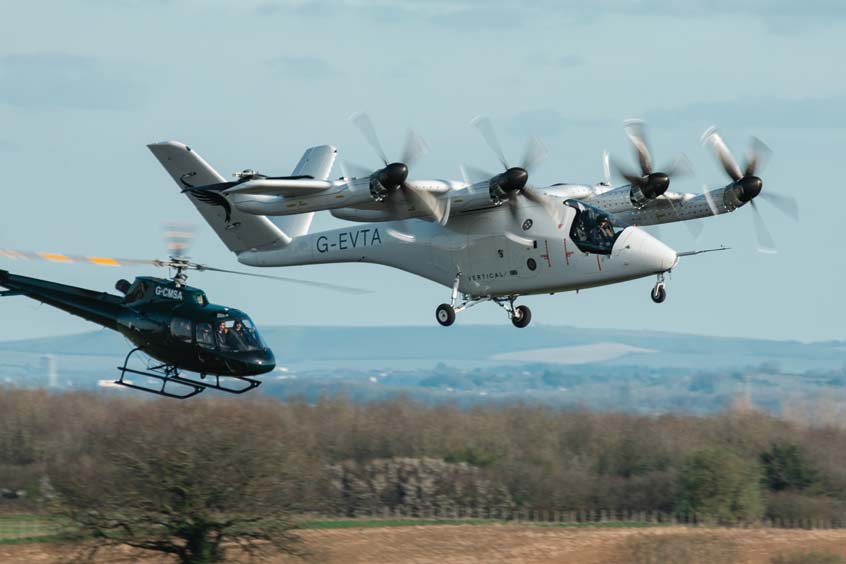
Photo: Vertical Aerospace
Test Pilot Paul Stone flew the transition sequence at Vertical’s Flight Test Centre at Cotswold Airport on 2 April 2026.
Vertical Aerospace, a global aerospace and technology company pioneering electric aviation, today announced a landmark achievement in aviation history: piloted thrustborne transition by a full-scale eVTOL aircraft, taking off vertically like a helicopter and transitioning seamlessly into wingborne flight like a fixed-wing aircraft.
This milestone unlocks the defining capability of eVTOL aviation and places Vertical at the forefront of the global advanced air mobility industry.
This marks a first for a piloted, full-scale eVTOL aircraft of this class operating under the oversight of the UK Civil Aviation Authority (CAA), which is working in close collaboration with the European Union Aviation Safety Agency (EASA) toward certification of Vertical’s electric aircraft, Valo.
This is the most significant technical milestone in Vertical’s ten-year history and represents the completion of the first half of the two-way transition sequence. In two-way transition, the aircraft takes off vertically, flies on the wing, and then decelerates to land vertically — without the need for a runway, enabling seamless point to point flight from helipads, vertiports and rooftops.
On April 2nd, 2026, Test Pilot Paul Stone flew the transition sequence at Vertical’s Flight Test Centre at Cotswold Airport. The aircraft took off vertically before the front propellers tilted forward, enabling a smooth acceleration into wingborne flight as the rear propellers stowed, followed by a conventional runway landing.
This flight demonstrates the aircraft’s ability to perform one of the most complex challenges in aviation: transferring lift from propellers to wings in real-world conditions, at full scale.
This milestone was achieved concurrently with Vertical announcing an agreement in principle for a financing package of up to $850 million on March 30th, 2026, to provide immediate capital and access to additional flexible capital as the Company continues to progress towards type certification and the commencement of commercial operations.
A systematic approach towards two-way transition
This achievement builds on nearly two years of piloted flight testing under strict regulatory oversight. During this time, the aircraft has demonstrated all key phases of eVTOL flight, including hover, vertical take-off, wingborne flight, and vertical landing. Additional milestones include the first winged eVTOL flight in open European airspace and an airport-to-airport flight at the Royal International Air Tattoo.
Vertical is systematically expanding the transition envelope from both ends — accelerating from hover and decelerating from wingborne flight — with this latest flight completing the former.
Supporting certification
Each expansion of the flight envelope is conducted under a strict Permit to Fly regime and contributes directly to the certification path for Valo, Vertical’s commercial aircraft.
Every test flight is supported by extensive structural testing, systems validation, simulator work, and the submission and review of detailed evidence to regulators before progressing further.
Stuart Simpson, Chief Executive Officer at Vertical Aerospace, said: “This marks a turning point not just for Vertical Aerospace, but for the entire advanced air mobility industry. Achieving piloted thrustborne transition under active regulatory oversight — alongside the recently announced financing package — demonstrates that we have solved the hardest engineering challenges, have the regulatory relationships to complete certification, and now have the financial foundation to see this through to commercial service.”
David King, Chief Engineer at Vertical Aerospace, said: “Completing this piloted transition milestone is a profound achievement and the result of years of engineering innovation and disciplined test execution. The aircraft performed exactly as designed, transitioning smoothly and under full control — proving the core elements of Vertical’s distributed electric propulsion and tiltrotor technology at full scale, in real flight conditions. This is not yet final mission accomplished, but it is a pivotal technical proof point on our path to two-way transition.”
Paul Stone, Test Pilot at Vertical Aerospace, said: “This aircraft was made to transition. From the moment the front propellers tilted and the aircraft began to accelerate, the response was exactly as the simulation predicted — smooth, stable, and fully under control throughout. What the engineering team has built here is genuinely extraordinary. The aircraft handled the transition with a level of confidence that gives me great optimism for everything that comes next.”
Vertical’s piloted flight test programme explainer:
- Phase 1: Tethered – stabilised hover while tethered (Completed September 2024)
- Phase 2: Thrustborne – vertical take-off, landing and low-speed manoeuvres (Completed February 2025)
- Phase 3: Wingborne – conventional take-off, flight and landing (Completed September 2025)
- Phase 4: Transition – transitioning between thrustborne and wingborne flight
- Thrustborne transition (vertical take-off to wingborne flight): Completed April 2026
- Two-way transition (including return to vertical landing): In progress
| Contact details from our directory: | |
| Vertical Aerospace Ltd | Airframer |
| Related aircraft programs: |
| Vertical Aerospace Valo |

Weekly news by email:
See the latest Bulletin, and sign up free‑of‑charge for future editions.
Safran plans €125m aircraft components plant in Wallonia
Honeywell and Odys combine for airborne drone defence
EU and India deepen cooperation through EASA-DGCA production alignment