Photo: Airbility
Airbility, a deep-tech aerospace and defence company developing high-speed electric vertical takeoff and landing aircraft, today announced that it has raised USD 4.7 million (KRW 6.5 billion) in Series A funding led by a Silicon Valley-based global VC Sazze Partners. The round brings Airbility's total funding to USD 7.6 million (KRW 10.5 billion). The company's valuation was not disclosed.
Existing investor Stonebridge Ventures participated with a follow-on investment, and Industrial Bank of Korea joined as a new shareholder. Airbility's existing investors also include Samho Green Investment, Mashup Ventures, BASS Ventures and 500 Global. The funding represents Sazze Partners' first investment in the defence sector. Founded in 2018, Sazze Partners has backed more than 100 companies across artificial intelligence, software and consumer technology, including Korean AI company Upstage.
Funding to scale an integrated counter-UAS portfolio
Airbility will use the proceeds to advance an end-to-end counter-unmanned aircraft system (counter-UAS), designed to physically defeat hostile drones in the air, while establishing the production infrastructure required for scale. The architecture is built around the company's high-speed eVTOL platforms and pairs airborne interceptors with onboard autonomy and external sensing assets.
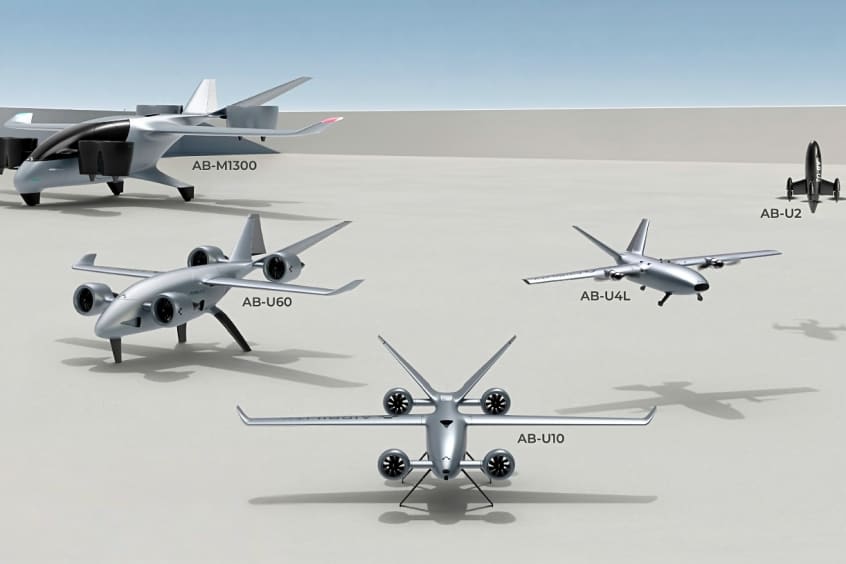
The portfolio includes the net-gun-equipped AB-U10, which is designed for speeds of approximately 180 kilometres per hour, and the AB-U60 mothership platform. Airbility is also developing two new interceptors: the AB-U2, a compact kinetic interceptor deployed from the mothership, and the AB-U4L, a fixed-wing, launcher-deployed interceptor designed for speeds of approximately 300 kilometres per hour. The company plans to commercialise the AB-U10 by the end of 2026 and the AB-U2 and AB-U4L in the first half of 2027, creating a three-interceptor lineup. The AB-U60 is targeted for launch in 2027.
Airbility will also enhance the onboard AI that powers its interceptors. The goal is to enable independent mission execution in communications-limited environments and connect the aircraft with external detection assets, including radar, electro-optical and infrared sensors. This will allow detection, interception and post-engagement assessment to operate as one coordinated system. Airbility will strengthen its manufacturing system in parallel, drawing on its in-house capabilities in 3D printing, composite airframes, battery packs and flight-control software.
Built for speed, affordability and exportability
Airbility was co-founded in November 2023 by researchers who helped develop Korea's KT-1, T-50 and KF-21 aircraft at the Agency for Defense Development, together with professionals from Hyundai Motor, the MIT Media Lab, LG Electronics and Genesis Design. Three of the company's senior technical leaders each spent between 25 and 31 years at the Agency for Defense Development. Of Airbility's 26 employees, approximately 80 percent work in research and development.
In December 2025, two years after its founding, Airbility completed transition-flight demonstrations across three prototype aircraft, validating the core design, flight-control logic and system integration behind its high-speed eVTOL platform. The 4-kilogram-class AB-U4 entered commercialisation in 2025.
The company is positioning its counter-UAS system to address a widening cost asymmetry in drone defence. A Shahed-type one-way attack drone is often cited at approximately USD 35,000, while a Patriot interceptor can cost about USD 4 million. Airbility estimates that its air-to-air approach can reduce the cost of an engagement to approximately USD 50 to USD 3,000, depending on configuration. The company also expects the domestically developed AB series to be priced at roughly one-tenth of comparable overseas systems, while offering greater flexibility for export customers facing origin restrictions and lengthy procurement processes.
Airbility is currently in commercial discussions with counterparties in more than nine countries across the Middle East, Southeast Asia and Latin America. Four memoranda of understanding and two joint-venture initiatives are in progress. In Korea, Airbility recently secured USD 2.2 million (KRW 3 billion) in R&D support through the Korea AeroSpace Administration's 2026 Scale-Up TIPS programme and is building domestic references through projects with the Republic of Korea Marine Corps and the Defense Acquisition Program Administration.
"Airbility is tackling the cost asymmetry in counter-drone defence with a system that combines a high-speed eVTOL mothership with small interceptors," said Kiha Lee, Partner at Sazze Partners. "We were impressed by the team's experience leading indigenous aircraft programs in Korea and by the speed with which it has moved from development to flight validation. If Airbility converts today's rapidly growing global demand into contracts, we believe it can become a defining Korean defence technology company."
"This investment gives us the resources to move faster," said Jinmo Lee, co-CEO of Airbility. "We will build on our validated high-speed eVTOL platform, commercialise our first counter-UAS aircraft this year, and establish a three-interceptor portfolio in the first half of next year. From there, we intend to expand from aircraft sales to integrated system sales, convert our overseas pipeline into contracts, and target KRW 50 billion in cumulative revenue by 2028."
| Contact details from our directory: | |
| Airbility | Airframer |
| Agency for Defense Development (ADD) | Airframer |
| Hyundai Motor Company Limited | Fuel Cells |
| Related aircraft programs: |
| KAI T-50 Golden Eagle |
| KAI KT-1 Woong Bee |
| KAI KF-21 Boramae |
| HESA Shahed 129 |
| Airbility AB Series |

Weekly news by email:
See the latest Bulletin, and sign up free‑of‑charge for future editions.
HAL and Safran finalise Aravalli engine deal
JetZero raises $100m as Z4 nears flight test
Bombardier acquires MHI Canada Aerospace assets