PRESS RELEASE
Issued by: NASA Langley Research Center
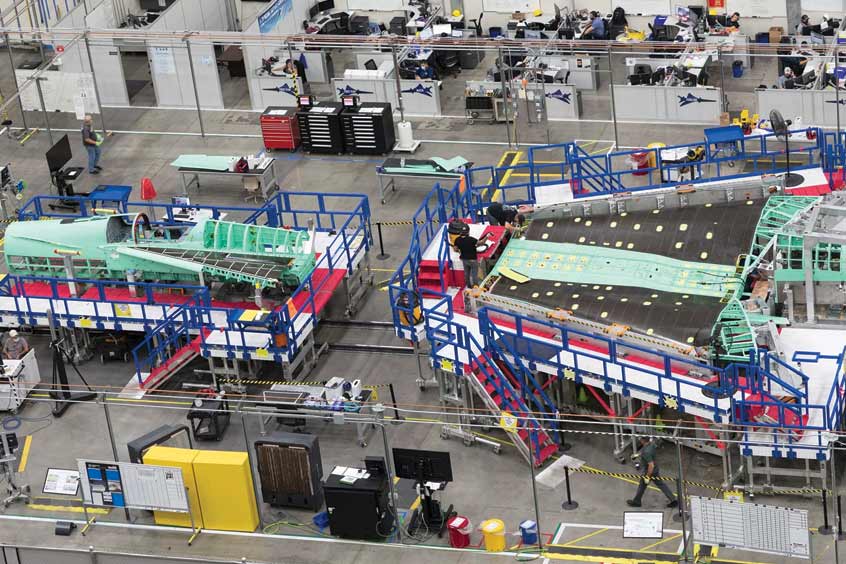
Photo:
The X-59 is halfway built. (Photo: Lockheed Martin)
NASA is on a mission to revolutionise supersonic air travel for passengers across the globe. The single-piloted X-59 Quiet SuperSonic Technology (QueSST) aircraft will be used to provide rule-makers the data needed to enable a new commercial market for faster-than-sound air travel over land. The aircraft’s uniquely crafted parts help ensure it will reduce a disruptive sonic boom to a quiet sonic thump to people on the ground when flying.
The X-59 team at Lockheed Martin in Palmdale, California, recently closed the structural backbone of the aircraft – the wing section – while simultaneously working on the plane’s forebody and empennage. The forebody section of the aircraft will carry the pilot and the avionics needed to fly the aircraft. The empennage supports the engine and other flight systems. The team will soon merge all three sections together and gear up for final assembly in 2021. The X-59 will undergo numerous tests to ensure structural integrity of the aircraft and that its components work properly. First flight of the aircraft will be in 2022, and community testing to understand the public’s perception of the X-59’s sound will begin in 2024.
| Contact details from our directory: | |
| NASA Langley Research Center | Research/Consulting Services, Wind Tunnels, Testing Services |
| Lockheed Martin Skunk Works | Airframer |
| Related aircraft programs: |
| Lockheed Martin Skunk Works X-59 QueSST |

Weekly news by email:
See the latest Bulletin, and sign up free‑of‑charge for future editions.
HAL and Safran finalise Aravalli engine deal
JetZero raises $100m as Z4 nears flight test
Bombardier acquires MHI Canada Aerospace assets