PRESS RELEASE
Issued by: Central Aerohydrodynamic Institute
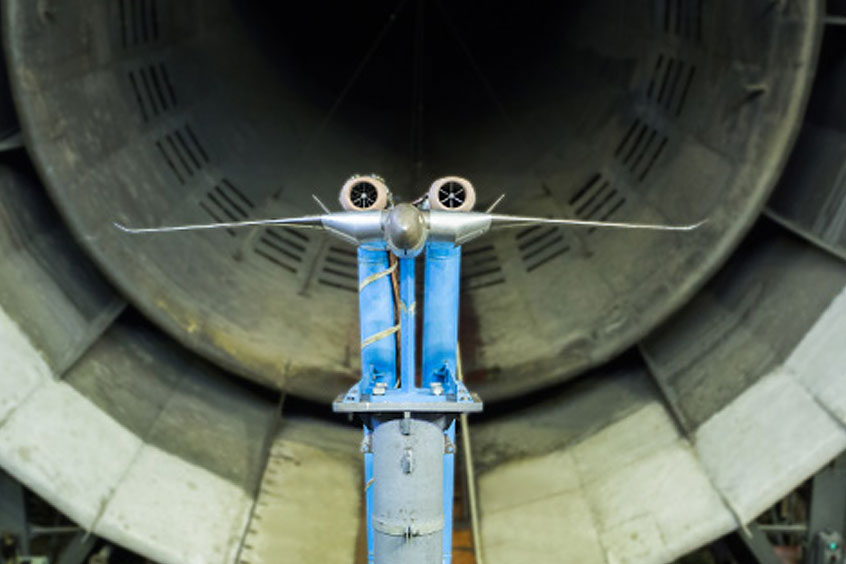
Photo:
The model aircraft with engines placed above the centre section is part of several new concepts for the creation of environmentally efficient air transport. (Photo: TsAGI)
The development of new solutions and concepts for the creation of environmentally efficient air transport is one of the promising tasks of the industry, in the implementation of which the Central Aerohydrodynamic Institute named after Professor N.E. Zhukovsky (part of the Research Centre "Institute named after NE Zhukovsky"). To implement it, the scientists of the Centre for Aviation Science tested a model of an aircraft in the "flying wing" scheme with engines located above the centre section.
The experiments carried out are one of the stages of research work "Development of concepts for the creation of mainline and regional aircraft of the next generation", which is carried out under a state contract with the Ministry of Industry and Trade of the Russian Federation.
The test object was a model of an aircraft (AC), made on a scale of 1:33. The peculiarity of the unconventional layout of the aircraft lies in the location of the engines above the centre section.
The purpose of the experimental research is to obtain the characteristics of the air intake in the "flying wing" type aircraft in take-off and landing modes. The results make it possible to check the correctness of its use and to determine the permissible operating modes as part of an aircraft.
"One of the most important advantages of a flying wing aircraft is that the noise of the power plant is shielded by the airframe. This effect is possible when the engines are located above the centre section. The installation of engine nacelles on pylons at the tail section of the centre section leads to severe unfavourable aerodynamic interference, which requires increased attention to the design of this unit. Previously, this problem was successfully solved and confirmed in a high-speed wind tunnel. Another important task is to ensure acceptable performance at high angles of attack at low flight speeds, including the characteristics of the oncoming flow in the air intake of the engines, "noted Ivan Chernyshev, head of the department of aerodynamics of aircraft and missiles at TsAGI.
The tests were carried out in a subsonic wind tunnel (WTA) T-104 TsAGI. In the future, the study of the model is planned to continue at other installations of the institute, in particular, in the transonic wind tunnel T-128.
The Flying Wing is one of the most promising configurations for future subsonic passenger and cargo aircraft. Its main advantage is the ability to obtain high aerodynamic quality in the cruise flight mode (over 23) and to drastically reduce the noise on the ground by shielding the engines with airframe elements. It is assumed that passengers can be comfortably accommodated on two decks of the "flying wing". This will not only allow transporting more people, but also improve the specific characteristics of the aircraft, including aerodynamics, weight and fuel consumption. Research on the formation of the appearance of a passenger liner of the LK scheme has been conducted at the institute for several years as part of research and development.
| Contact details from our directory: | |
| Central Aerohydrodynamic Institute | Academic Institutions, Wind Tunnels, Acoustic Testing Services, Simulation Services, Fatigue Testing |
| Related directory sectors: |
| Test Services |

Weekly news by email:
See the latest Bulletin, and sign up free‑of‑charge for future editions.
HAL and Safran finalise Aravalli engine deal
JetZero raises $100m as Z4 nears flight test
Bombardier acquires MHI Canada Aerospace assets