PRESS RELEASE
Issued by: Stratasys Ltd
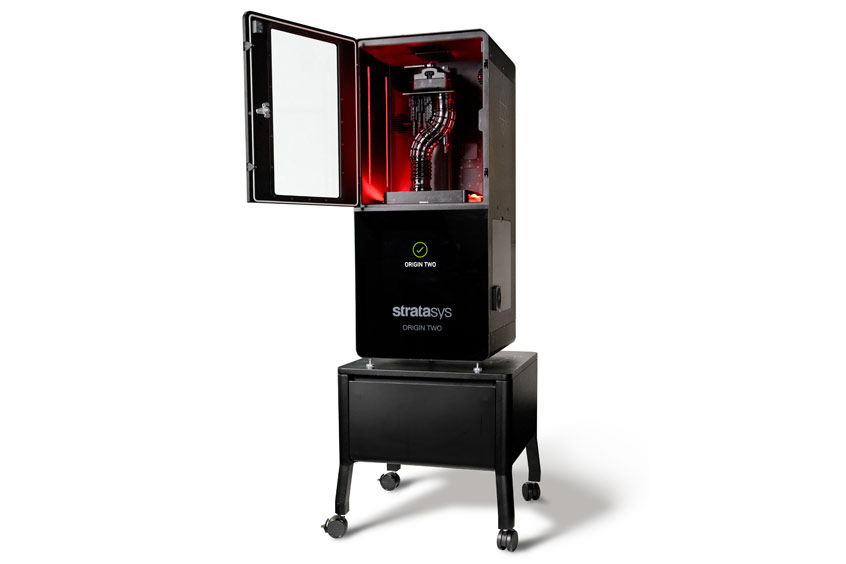
Photo: Stratasys
Stratasys' Origin Two DLP printer
Stratasys today announced the availability of the Origin Two DLP printer in tandem with its own post-processing system, the Origin Cure™. This solution addresses the growing demand among manufacturers for injection-molding quality for short production runs, delivering a level of accuracy, repeatability, and surface finish previously unattainable with additive manufacturing.
Traditional high-volume manufacturing is under pressure due to a myriad of challenges, such as supply chain disruptions, material shortages, and changing consumer preferences. There is a growing demand for low-volume production solutions to offset the costs of mass production. Additive manufacturing with the new Origin Two is designed to eliminate the high setup and tooling costs typical for low to medium volume production, while meeting customers' most stringent precision requirements.
The new Origin Two, with Origin Cure, aims to address the key pain points by enabling manufacturers to:
- Ensure that end parts meet required properties by maintaining stringent quality controls
- Bring production in-house, thereby reducing reliance on third parties
- Improve inventory management and lower warehousing costs with on-demand delivery of spare parts
- Consolidate part manufacturing into a single process with better consistency
“Additive manufacturing has grown to be a critical component of production at any scale on the manufacturing floor,” said Rani Hagag, Chief Healthcare and Consumer Business Officer, Stratasys. “With the new Origin® solution, manufacturers in need of low volume, high precision parts now have an alternative to mass production that can meet their most stringent requirements, something which was not possible with additive before.”
The new solution is designed to achieve consistently higher accuracy of +/- 50 µm, critical for industries such as connectors, aerospace and automotive. For applications such as seals and gaskets, housings and window parts, it provides additional essential features including:
- Achieving repeatability of more than 93% within +/- 50 µm across Origin Two printers, and surface finish smoothness of up to RA 3 µm, while maintaining high-print speeds up to 20 mm/hour.
- The heated chamber of the Origin Two enables reliable printing of materials with a Heat Deflection Temperature (HDT) of up to 300°C, making it suitable for a wide range of high-performance applications.
- Running on a 385-nanometer wavelength, the Origin Two system supports a broad range of high-performance materials, from high-temperature resins to high-viscosity formulations.
"Additive manufacturing is becoming increasingly valuable for low production volumes in the manufacturing sector,” said Ryan Martin, Senior Research Director, ABI Research. “Manufacturers are using 3D printing for low-volume and custom parts, which helps reduce lead times and waste. This allows for greater flexibility and cost efficiency, supporting both prototyping and on-demand production. As a result, additive manufacturing is proving to be a practical solution for companies looking to adapt quickly to market needs and reduce inventory costs."
The new hardware is commercially available starting September 5th.
| Contact details from our directory: | |
| Stratasys Ltd | Injection Moulding, Models, Machining Systems, Additive Manufacturing (Resin) |
| Stratasys Direct Manufacturing | Thermoplastics, Additive Manufacturing, Brackets, Prototyping, Machining Services, Jigs & Fixtures, Additive Manufacturing (Resin), Aircraft Interiors, Manifolds & Ducts, Project Management, Manufacturing Consultants, Air Filters, Cabin Signage & Displays, Fabricating Services, Final Assembly, Lavatory Equipment, Mandrels |
| Related directory sectors: |
| Processes |
| Plastics |

Weekly news by email:
See the latest Bulletin, and sign up free‑of‑charge for future editions.
HAL and Safran finalise Aravalli engine deal

JetZero raises $100m as Z4 nears flight test
Bombardier acquires MHI Canada Aerospace assets