PRESS RELEASE
Issued by: .
Libertine FPE has been selected by Cranfield University to supply a turnkey single-cylinder opposed free piston research engine for combustion experiments as part of the MINIMAL project to reduce the climate impact of aviation.
The MINIMAL project, a European consortium of leading industrial and academic partner organisations funded by Horizon Europe and UKRI, is assessing internal combustion technologies for future composite-cycle aero engines running on hydrogen or a sustainable aviation fuel. These engines will deliver net zero CO2 emissions with reduced fuel consumption and minimal climate impact.
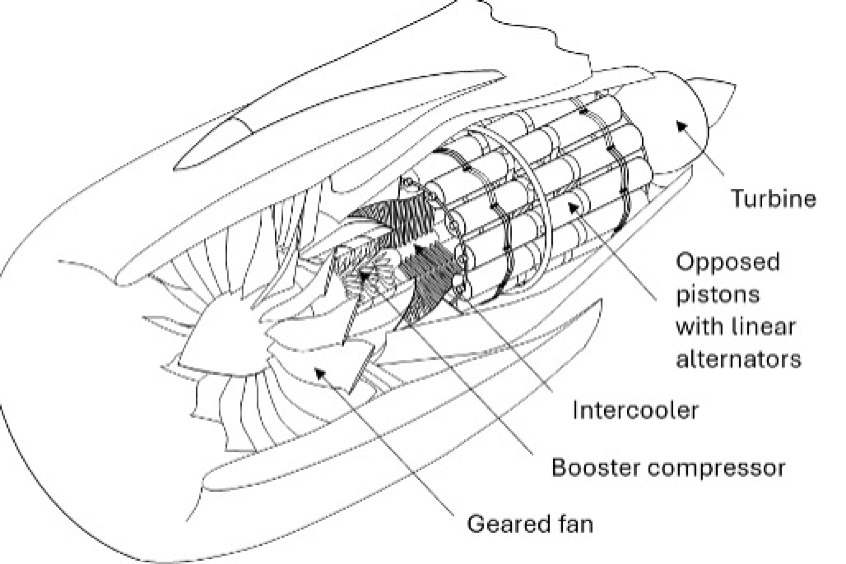
In a preferred engine concept from Cranfield University, the exhaust from a turbocharged multi-cylinder set of opposed free piston gas generators drives a turbine that powers the fan. The free piston gas generators also generate electric power via linear alternators and this is used to help drive the fan and booster compressor, giving a significant improvement in overall efficiency relative to a conventional turbofan engine. The experiments to be conducted at Cranfield will investigate alternative fuel injection and ignition systems to maximise efficiency and minimise NOx emissions for hydrogen-fuelled engines.
Libertine’s ‘intelliGEN’ opposed free piston engine and control technology platform has the potential to deliver double-digit percentage improvements in fuel economy when integrated into commercial aero engines. Libertine has incorporated the intelliGEN platform into its ‘OpenFPE’ product, a research engine solution that will be supplied to Cranfield University.
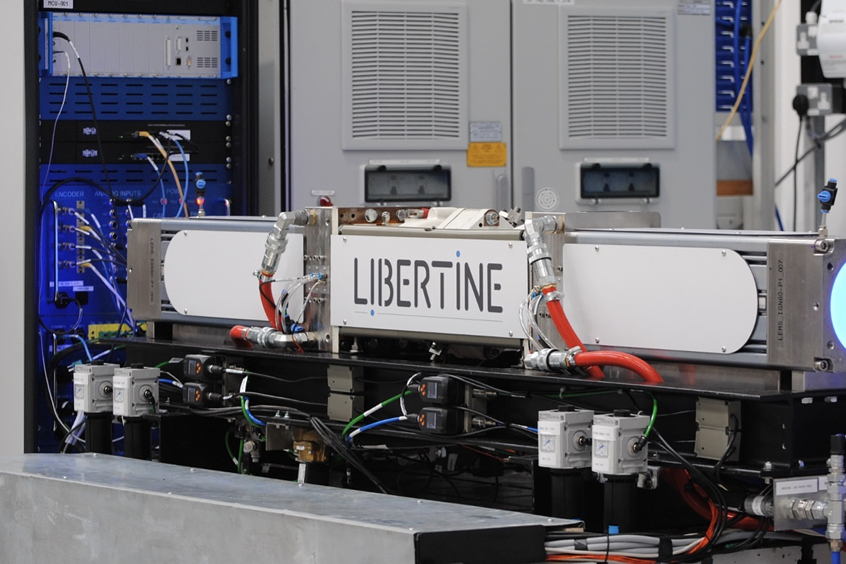
OpenFPE is a turn-key free piston research engine solution for advanced combustion development and renewable fuels research programmes, combining a single cylinder opposed free piston Linear Generator module with the necessary power electronics, motion controls and auxiliary systems for operating the system. OpenFPE has been designed to enable combustion system components to be modified or swapped, and to improve research and development productivity with tools for system modelling, data acquisition and analytics.
Sam Cockerill, Chief Executive of Libertine, said: “OpenFPE is the first ever research engine that offers real-time compression ratio control, multi-fuel capability and a customer-configurable combustion system. It provides leading research organisations with the means to quickly integrate intelliGEN free piston technology into their programmes, shortening the development cycle and allowing researchers to focus on experimental validation of a wide range of new engine and power generation architectures.”
Andrew Rolt, Senior Research Fellow at Cranfield University, said: “The Libertine OpenFPE research engine is ideal for our combustion experiments in the MINIMAL project. Its flexibility will enable us to make NOx emissions measurements over a wide range of operating conditions representative of those to be encountered in a future hydrogen-fuelled commercial aero engine.”
| Contact details from our directory: | |
| Cranfield University Aerospace | Research/Consulting Services, Welding, Accident Investigation, Human Factors Engineering, Project Management, Reliability & Maintainability Services, Systems Analysis, Logistics Consultants, Marketing Consultants, Management Studies, Design Services, Academic Institutions, Fuel Cells |
| Related directory sectors: |
| Design |

Weekly news by email:
See the latest Bulletin, and sign up free‑of‑charge for future editions.
HAL and Safran finalise Aravalli engine deal

JetZero raises $100m as Z4 nears flight test
Bombardier acquires MHI Canada Aerospace assets