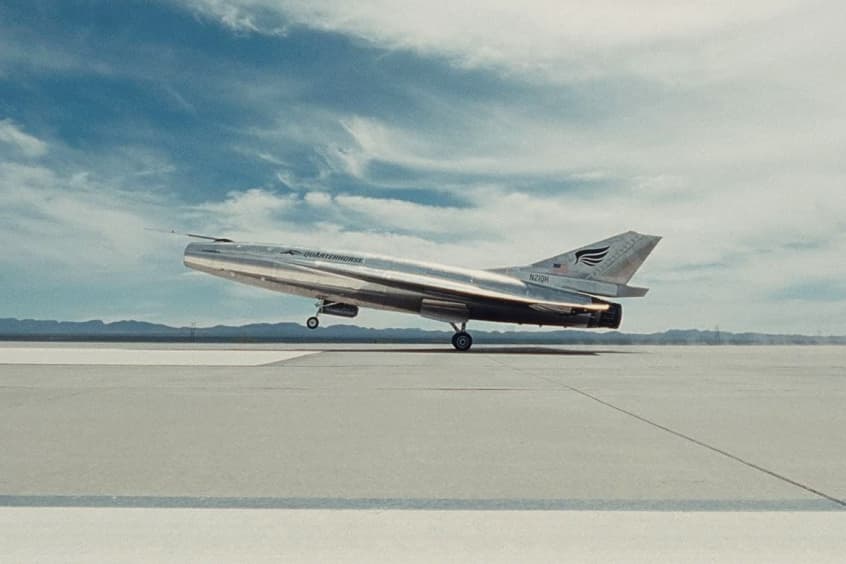
Photo: Fraunhofer ILT, Aachen, Germany
The aerospace industry is one of the beneficiaries of current developments in metallic 3D printing. Small quantities and the high complexity of lightweight, high-performance components are already among the strengths of additive manufacturing.
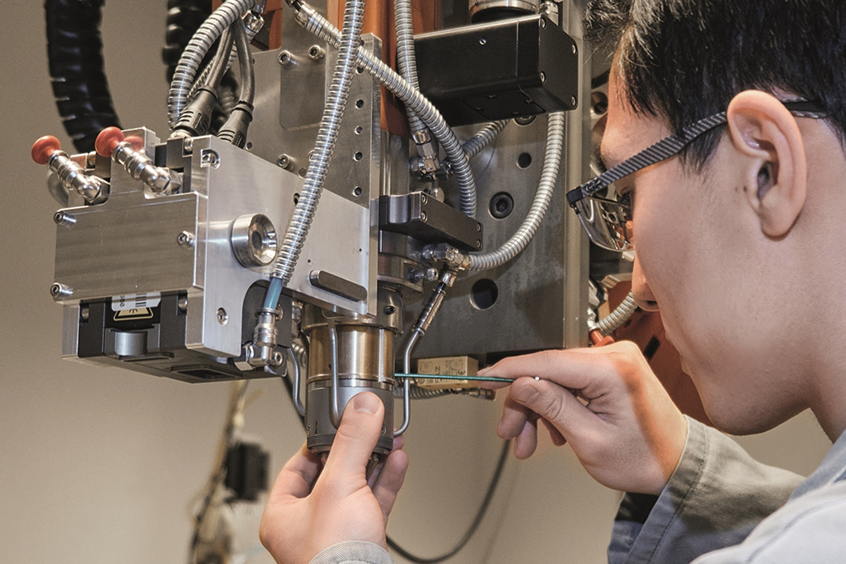
Photo: Fraunhofer ILT, Aachen, Germany / Ralf Baumgarten
The LMD technology process principle can be transferred to almost any system kinematics. It can be used to apply extremely hard alloys that are particularly stable over the long term.
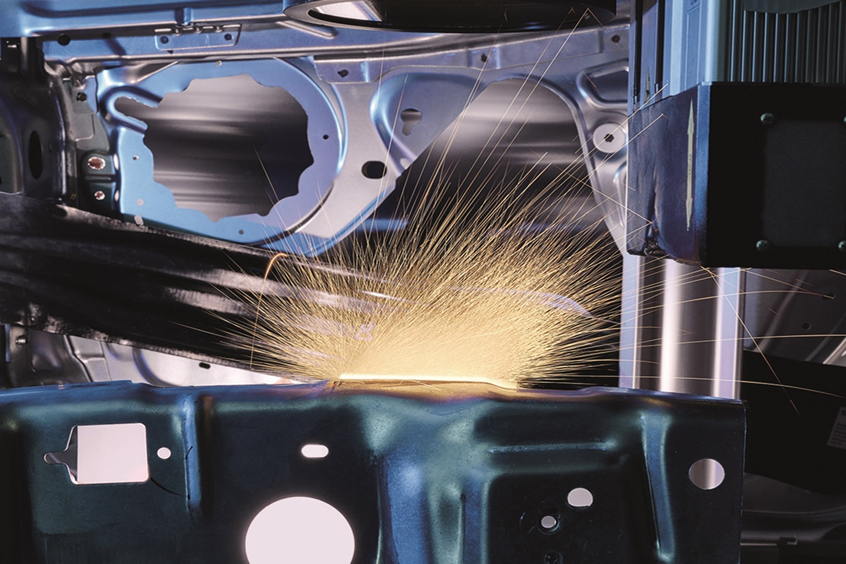
Photo: Fraunhofer ILT, Aachen, Germany / Volker Lannert
Laser material deposition: A flexible and fast alternative to conventional production with forming, welding and mechanical processing.
The aerospace industry is undergoing profound change. Companies are facing the challenge of having to drastically shorten development cycles, develop more sustainable technologies and reduce costs, all at the same time. In addition, advances in satellite technology require new manufacturing approaches to make systems smaller, lighter and more powerful. While government space programs continue to play a major role here, private players such as SpaceX, Blue Origin and Rocket Lab are driving the commercialization of space travel and setting new standards for efficiency and profitability: Competition has never been so fierce.
In parallel, climate change requires innovative solutions in aviation. The industry is under pressure to introduce alternative propulsion systems, use sustainable materials and develop emission-free aircraft. National and international regulations could soon raise the carbon tax on pollutant emissions in the future and enforce stricter requirements for sustainable flying.
This is where the Fraunhofer Institute for Laser Technology ILT comes into play. Indeed, state-of-the-art laser technology can address many of these challenges: Laser-based manufacturing and measurement technologies enable industries to produce complex parts as well as lighter and more powerful components faster, more flexibly while also saving resources. Processes such as laser powder bed fusion (LPBF) and laser material deposition (LMD) can be used to efficiently produce or repair high-performance components for aircraft, launch systems and satellites.
Additive manufacturing for the aerospace industry
The basic patent for LPBF, the metallic 3D printing process developed at Fraunhofer ILT, forms the basis for today's prototype construction and production of functionally optimized components in the aerospace industry. With it, development cycles can be drastically shortened. The path from CAD model to prototype now only takes a few days – which used to take several months – while reducing costs at the same time. Design engineers have more freedom and can test different variants in parallel.
"Wherever tailor-made, highly complex components are required, additive manufacturing can fully exploit its advantages in terms of flexibility," explains Dr. Tim Lantzsch, head of the Laser Powder Bed Fusion Department at Fraunhofer ILT. "In the aerospace industry, additive manufacturing offers enormous opportunities to optimize components while reducing weight and material usage."
Fraunhofer ILT is also continuing to develop LPBF for copper materials, another example of how the institute is advancing additive manufacturing (AM) for the industry. Since it has such high thermal conductivity, copper is ideal for components that have to withstand extreme thermal loads, such as combustion chambers in rocket engines.
The LPBF team at Fraunhofer ILT has extended the process limits for copper alloys by specifically using green laser radiation to process GRCop42 (CuCrNb). With this development, they can produce high-density, thin-walled structures with optimized thermal management. Such structures have a decisive advantage for space applications, which require durable components manufactured more efficiently and at reduced costs.
LMD is another established AM process for manufacturing components with high precision and optimum material properties. In the ENLIGHTEN project (European iNitiative for Low cost, Innovative & Green High Thrust ENgine), LMD is used to manufacture components with optimized topology, reduced weight and maximum resilience. "The special thing is that we are significantly improving the speed and cost-effectiveness of manufacturing new generations of rocket nozzles thanks to the diverse possibilities of LMD technology. Apart from its large installation space, the design under investigation has exceptionally filigree and thin-walled cooling channels, which can only be manufactured with conventional production routes at great expense," explains Dr. Thomas Schopphoven, head of the Laser Material Deposition Department at Fraunhofer ILT.
LPBF is also increasingly being used to manufacture structural aircraft components that have high strength, but need less material. This process enables users to produce lightweight components that improve the efficiency of modern aircraft. In addition, AM contributes to the efficient repair and maintenance of aerospace components. With LMD, damaged components can be replaced in a targeted manner – an important step towards lean supply chains, sustainability and cost reduction.
Lightweight construction and hybrid materials: new joining technologies for stable, lightweight components
Lower fuel consumption, lower emissions and increased payloads; lighter and more stable structures are key aspects toward developing more efficient aircraft and space systems. Hybrid materials that combine plastics and metals offer a promising solution. To ensure that these materials can be joined reliably, Fraunhofer ILT has developed joining technologies – e.g., laser structuring for plastic-metal hybrid components – that generate a mechanically resilient and long-term stable connection. In this process, the metal surface is first structured with a laser to create micropores, which are then filled with plastic, creating a particularly strong and resistant bond.
"Thanks to precise laser structuring, we can significantly improve the adhesion between metal and plastic and develop hybrid components that are both lighter and mechanically more robust," explains Dr. Alexander Olowinsky, head of the Joining and Cutting Department at Fraunhofer ILT. This process makes it possible to produce metal-plastic joints that have the necessary structural strength for use in wings, fuselage structures and engine components.
Laser transmission welding for fiber composites is also an important innovation for modern lightweight construction. Here, the joining zone absorbs the laser beam, allowing heat-resistant plastic components to be securely joined to fiber composites. The method improves the mechanical strength and service life of these materials while reducing their manufacturing costs. "The advantages of processing hybrid materials with laser technology are weight savings, higher strength and durability of the joints, cost savings through low-maintenance joining processes and laser-based repair techniques," summarizes Olowinsky.
The laser institute is also conducting research on LMD with aluminum alloys. "As aluminum has a high thermal conductivity, welding is traditionally a challenge," says Thomas Schopphoven. "The adapted LMD process can generate high-strength, precise weld seams that do not place unnecessary stress on the material. This technology is particularly suitable for weight-saving structural elements in aircraft and spacecraft." Thanks to these developments, Fraunhofer ILT is helping to make the aerospace industry more efficient, sustainable and economical.
Innovations for the next generation of aerospace
Corrosion and material fatigue are general challenges in the aerospace industry since components have to withstand extreme conditions such as high temperatures, vibrations and harsh environments. Fraunhofer ILT is developing laser-based coating technologies that reduce the wear of components and extend their service life. These include the LMD process in particular, as well as thin-film technologies. Specifically, the institute is focusing on thermal barriers for engines and high-strength protective coatings for aircraft and satellite components.
Through targeted laser treatment such as LMD coating and heat treatment, material properties can be adapted to ensure greater resistance to corrosion and mechanical wear. This not only contributes to increased safety, but also reduces maintenance costs and extends the service life of critical systems.
Digitalization and artificial intelligence (AI) are increasingly being used to develop materials and economical concepts for the aerospace industry. This includes detecting errors in production automatically, optimizing laser-based joining techniques for new material classes and integrating AI into process monitoring.
With its interdisciplinary research approach, Fraunhofer ILT, Europe's largest research center in the field of laser technology, is a key player in aerospace innovation. The institute's developments contribute to building more efficient, more sustainable and more powerful systems for the future.
| Contact details from our directory: | |
| Fraunhofer Institute for Laser Technology - ILT | Research/Consulting Services, Additive Manufacturing, Welding, Laser Welding, Boring & Drilling Services, Laser Drilling, Metal Finishing/Polishing, Turbine Engine Blades, Design Services |
| Blue Origin | Airframer |
| Rocket Lab | Airframer |
| Related directory sectors: |
| Processes |

Weekly news by email:
See the latest Bulletin, and sign up free‑of‑charge for future editions.
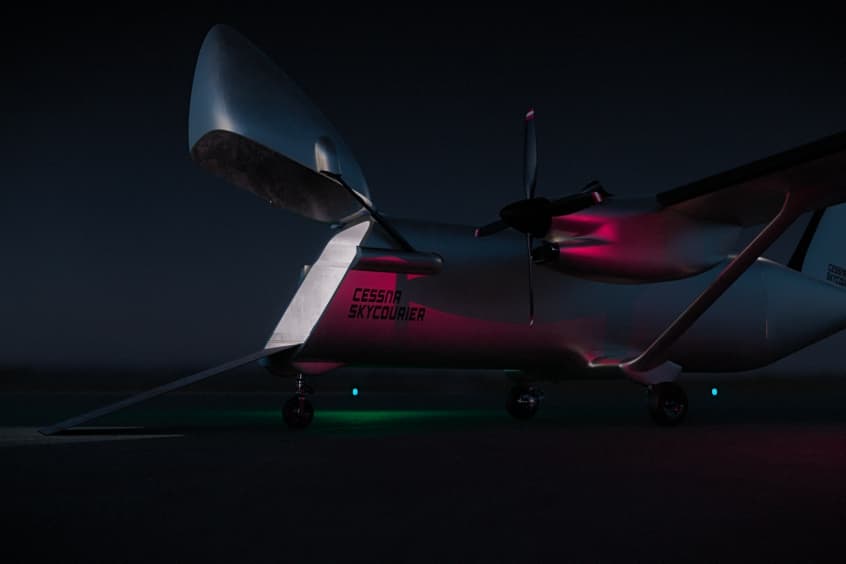
Textron and Merlin unveil pilot-optional SkyCourier concept

G2E consortium wins 18-month GCAP electronics contract
GE advances XA102 adaptive cycle engine