Photo: AnalySwift
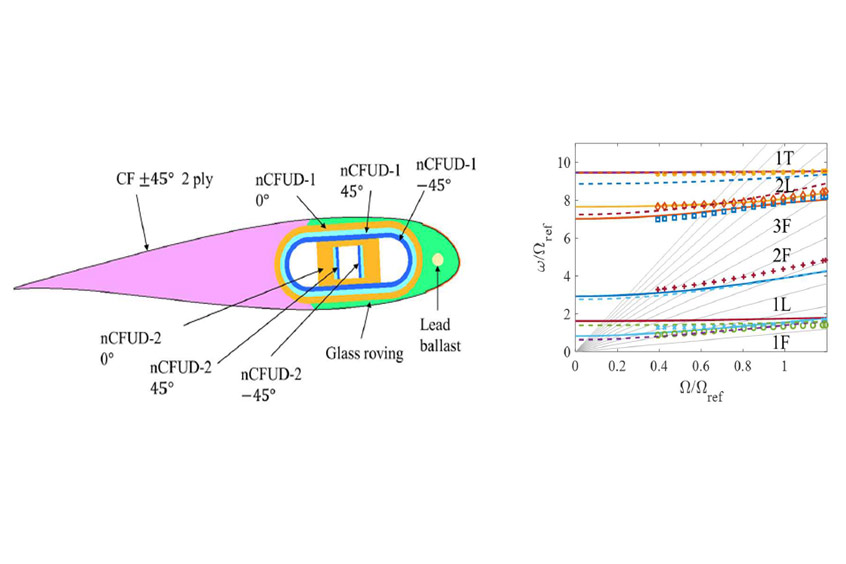
Blade section design and fan plot examples for analyzing the vibration characteristics of UAM (Im, B., Lee, H., Kong, K., Ko, G., & Shin, S. (2023). Aeromechanical and aeroelastic effects of the blade structural design of a coaxial rotor by the physically coupled mid-fidelity aerodynamics. In The Vertical Flight Society’s 79th Annual Forum and Technology Display.)
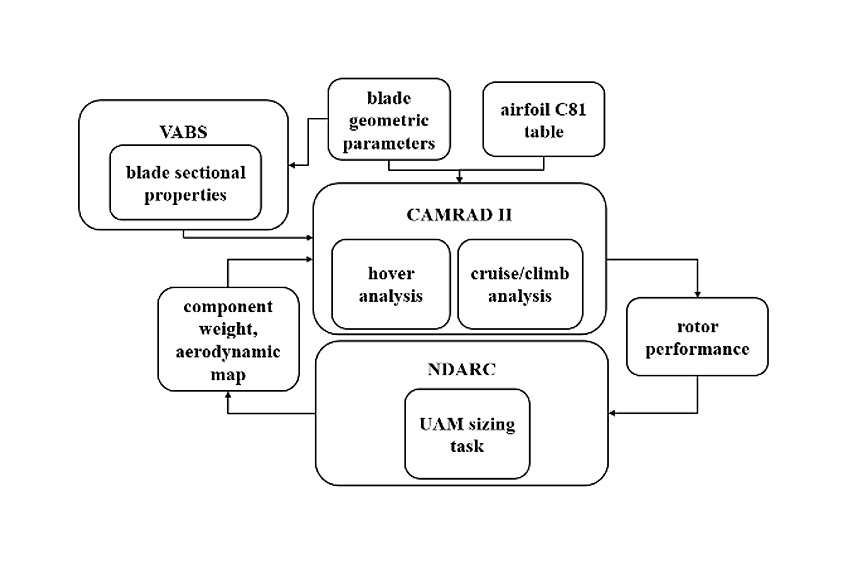
Photo: AnalySwift
Overall UAM design and iterative flowchart
AnalySwift, LLC, a provider of efficient high-fidelity modeling software for composites, announced today that Seoul National University (SNU) has been participating in its Academic Partner Program (APP), and it has been using its VABS simulation software for analyzing the rotor blades for urban air mobility (UAM) and the other rotorcraft. The work is part of the Active Aeroelasticity and Rotorcraft Laboratory (AARL) in the Department of Aerospace Engineering at Seoul National University and SNU-UAM Center, a research center dedicated to developing the core technologies for Urban Air Mobility (UAM).
The APP offers participating universities no-cost licenses of engineering software programs VABS and SwiftComp so students, researchers, and faculty can leverage the tools in their academic research.
The VABS program is a general-purpose cross-sectional analysis tool for predicting structural beam properties and recovering 3D stresses, strains, and strengths of slender composite structures. It is a powerful tool for modeling composite rotorcraft (helicopter, air mobility, unmanned aerial vehicles) and wind turbine rotor blades, as well as other slender composite structures, such as propellers, landing gear, and high-aspect ratio wings.
“We are excited by the work being done by the Seoul National University as part of and pleased they have found VABS helpful in as part of their design and analysis workflow as they optimize aerospace structures,” said Allan Wood, president & CEO of AnalySwift. “As a versatile cross sectional analysis tool, VABS delivers high-fidelity results early on to help computationally resolve engineering challenges, reduce trial and errors, and arrive at the best solution more quickly.”
“SNU-UAM Center brings together 12 laboratories from 7 universities, including Seoul National University, with the goal of securing the core technologies for Urban Air Mobility (UAM),” said Professor SangJoon Shin of the Department of Aerospace Engineering at Seoul National University.
“To ensure the safe operation of UAM vehicle, it will be essential to avoid the ground resonance, and VABS enables us to design the rotor blade cross section that avoids resonance within the operational frequency range. We have been using VABS program to perform cross-sectional design based on the given geometries and to achieve the desired vibration characteristics for the rotor blades integrated with a gimballed hub,” Professor Shin explained. “First, we designed the blade cross section and used VABS to obtain the corresponding stiffness matrix. Then, we provided this result into CAMRAD II, a performance analysis program for a rotorcraft, to compute the vibratory response under the realistic flight condition.”
“The VABS program is a uniquely powerful tool for modeling composite blades, high aspect ratio wings, and other slender structures, commonly called beams,” said Dr. Wenbin Yu, CTO of AnalySwift. “VABS reduces analysis time from hours to seconds by quickly and easily achieving the accuracy of detailed 3D finite element analysis (FEA) with the efficiency of simple engineering models. With VABS, engineers can calculate the most accurate, complete set of sectional properties such as torsional stiffness, shear stiffness, shear center for composite beams made with arbitrary cross-section and arbitrary material. It can also predict accurate detailed stress distribution for composite beams, which are usually not possible with 3D FEA for realistic composite structures.”
| Contact details from our directory: | |
| Vertical Flight Society (VFS) | Trade Organisations |
| AnalySwift LLC | Computer-aided Simulation, Computer-aided Design |
| Seoul National University, Department of Aerospace Engineering | Academic Institutions, Research/Consulting Services, Technical/Eng/Scientific Studies |
| Related directory sectors: |
| Design Software |

Weekly news by email:
See the latest Bulletin, and sign up free‑of‑charge for future editions.
HAL and Safran finalise Aravalli engine deal
JetZero raises $100m as Z4 nears flight test
Bombardier acquires MHI Canada Aerospace assets