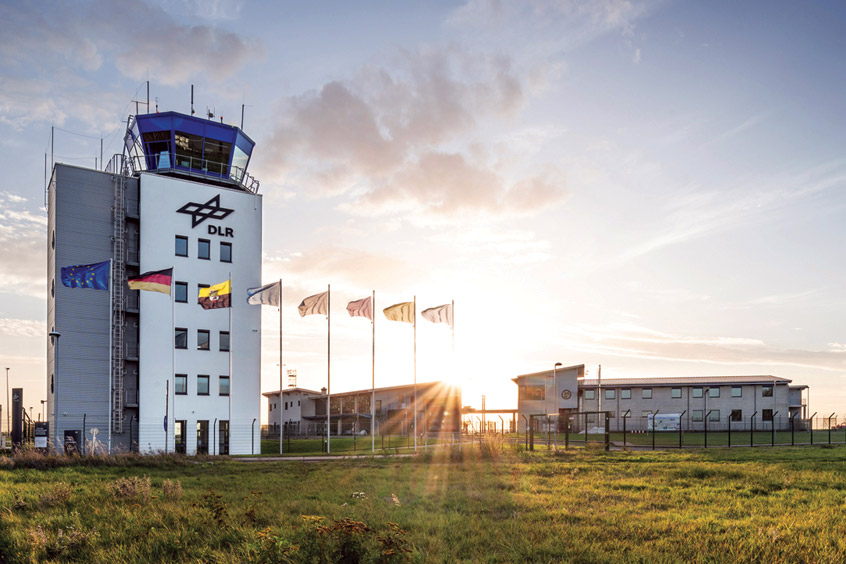
Photo: DLR
The National Experimental Test Center for Unmanned Aircraft Systems at the DLR site in Cochstedt, Germany: With the National Experimental Test Center for Unmanned Aircraft Systems at Magdeburg–Cochstedt Airport, DLR has established a highly innovative competence centre for unmanned aircraft systems (UAS) that is unique in Europe. Due to the rapid growth of the entire sector, the number of system tests is also increasing significantly. Opened in 2021, the National Experimental Test Center enables holistic technology development and serves as a trailblazer for future research and development of new UAS technologies at DLR and with external industrial partners.
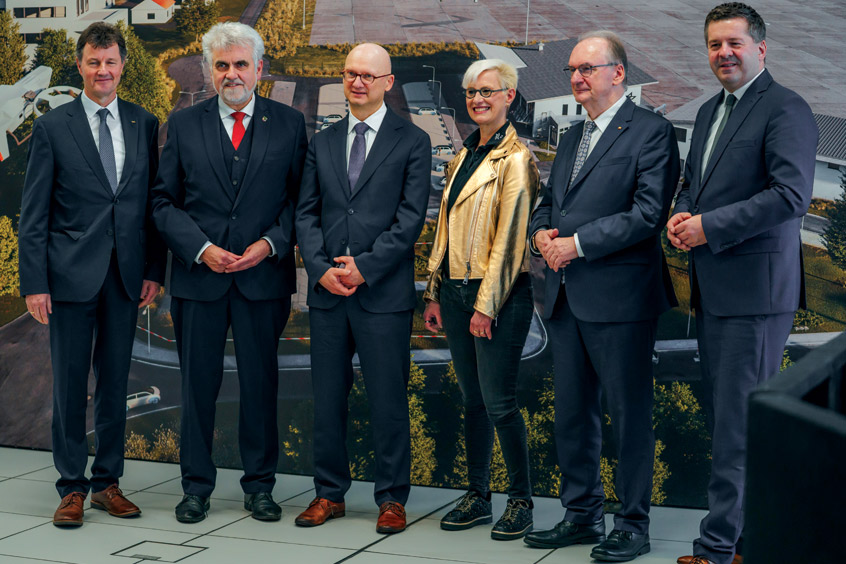
Photo: DLR
Advancing the DLR site in Cochstedt together: At the 'In dialogue: knowledge and technology' event on 8 December 2025, DLR invited guests to Cochstedt for an exchange of views. From left to right: Markus Fischer, DLR Divisional Board Member for Aeronautics; Armin Willingmann, Minister for Research, Energy, Climate Protection and the Environment of the state of Saxony-Anhalt; Marcus Pleyer, State Secretary at the Federal Ministry for Research, Technology and Space; Anke Kaysser-Pyzalla, Chair of the DLR Executive Board; Reiner Haseloff, Minister-President of Saxony-Anhalt; and Sven Schulze, Minister of Economic Affairs, Tourism, Agriculture and Forestry of the state of Saxony-Anhalt.
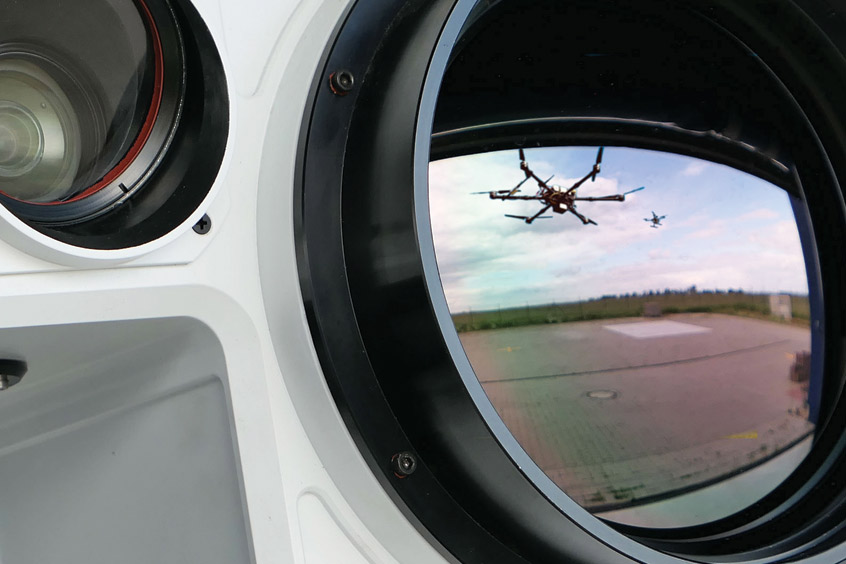
Photo: DLR
System for drone detection: The mobile detection system identifies drones at an early stage. It can also be used to determine their position. In the CUSTODIAN project (Counter-UAS Technologies for Detection, Interception and Neutralization), 12 DLR institutes and facilities, led by the DLR Institute of Flight Systems, are pooling their expertise in counter-drone technologies. DLR is working on a wide range of technical solutions. Researchers at DLR’s National Experimental Test Center for Unmanned Aircraft Systems in Cochstedt have successfully demonstrated how a hostile drone can be detected and neutralised.
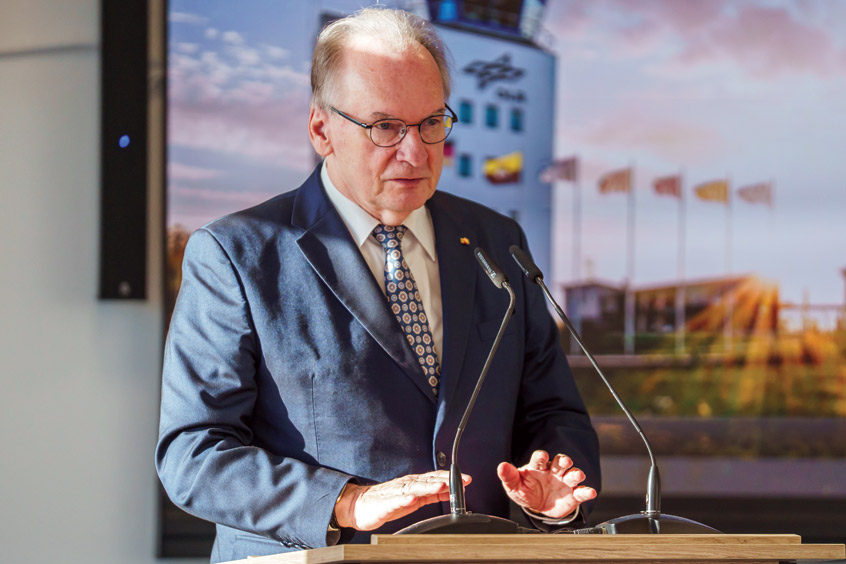
Photo: DLR
Reiner Haseloff, Minister-President of the state of Saxony-Anhalt: Minister-President Reiner Haseloff speaks at the event on 8 December 2025 at DLR's National Experimental Test Center for Unmanned Aircraft Systems in Cochstedt.
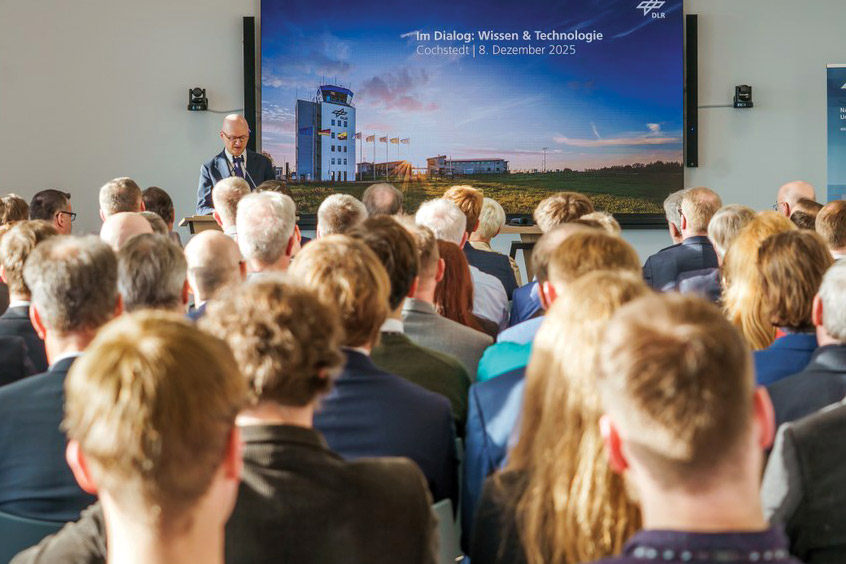
Photo: DLR
Marcus Pleyer, State Secretary at the Federal Ministry for Research, Technology and Space: Marcus Pleyer, State Secretary at the Federal Ministry for Research, Technology and Space, speaks at the DLR site in Cochstedt on 8 December 2025. Numerous guests from politics, business, research and public authorities were invited.
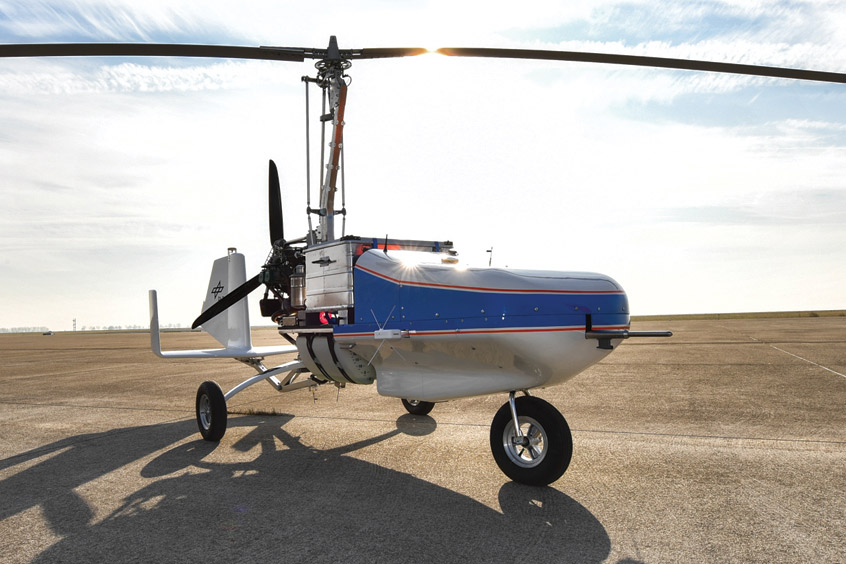
Photo: DLR (CC BY-NC-ND 3.0)
ALAADy: Through the ALAADy (Automated Low Altitude Air Delivery) project, the DLR Institute of Flight Systems is conducting research into automated uncrewed air transport at low altitudes.
Testing uncrewed aircraft while a commercial airport is in operation – this is possible at the Cochstedt site of the German Aerospace Center (Deutsches Zentrum für Luft- und Raumfahrt; DLR). Over the past few years, this has led to the establishment of a drone test centre in Saxony-Anhalt that is unique in Europe. DLR has now invested approximately 20 million euros in the National Experimental Test Center for Unmanned Aircraft Systems, upgrading the site, creating new test infrastructures and progressively expanding flight operations. Most recently, following extensive conversion work, the former terminal building has been transformed into the main building of the test centre. Just a few days ago, a permanent GeoZone was also established for the Cochstedt test area. Within this area, complex drone test flights – including with large uncrewed aircraft and beyond visual line of sight – can now be conducted without the otherwise time-consuming and lengthy individual approvals. This marks another building block in establishing Cochstedt as a comprehensive real-world laboratory that is paving the way for the emerging 'drone economy'. Here, the integration of uncrewed aircraft into future transport systems is being tested, along with new, forward-looking drone technologies and counter-drone solutions.
"The development of uncrewed aircraft systems has accelerated enormously. This is driven by a wide range of applications and security challenges, such as protecting energy infrastructure. Airports are also increasingly affected by drone-related incidents. At the National Experimental Test Center for Unmanned Aircraft Systems in Cochstedt, we test drone technologies for both operations and defence. At the same time, the site enables start-ups, industry and public authorities to take the crucial development steps towards real-world deployment. In doing so, we strengthen the innovative capacity and competitiveness of our economy in an important key technology and enhance our resilience in security-relevant applications." - Anke Kaysser-Pyzalla, Chair of the DLR Executive Board.
Over recent years, and in cooperation with policymakers and authorities at federal and state level, extensive opportunities have been created at Cochstedt for the use of technologies that would be unthinkable at a 'normal' airport – such as the test use of jamming signals, laser technologies or the simultaneous test operation of crewed and uncrewed aircraft (Unmanned Aircraft Systems, UAS). This also allows Cochstedt to play a very special role in the field of drone defence. Realistic scenarios are tested here, and solutions are developed that can subsequently be transferred to other airports and security-critical infrastructures.
"Uncrewed aircraft systems – commonly known as drones – are essential today, both in everyday life and in crisis situations. In Germany, we have to master drone technologies in order to equip not only civilian users in business and industry, but also emergency responders such as the fire brigade and the Federal Agency for Technical Relief (Technische Hilfswerk; THW), as well as the police and the armed forces, in the best possible way. Only then can our society fully benefit from the economic potential while being as well protected as possible. The DLR site in Cochstedt offers a unique drone test centre and enables our researchers and developers to bring drone technology 'Made in Germany' to technological excellence," said Dorothee Bär, Federal Minister for Research, Technology and Spaceflight.
"With DLR's test centre in Cochstedt, we have an outstanding facility in Saxony-Anhalt with great scientific expertise in the research and use of uncrewed aviation systems. I am certain that it will drive the region forward and strengthen Saxony-Anhalt as a location for innovation in the long term. I would like to thank DLR and everyone who has contributed to the success of this project," said Reiner Haseloff, Minister-President of the state of Saxony-Anhalt.
Development, testing, approval and certification
At the DLR site in Cochstedt, a wide variety of aircraft and operational scenarios can be tested individually or in combination as a system-of-systems. The focus is on testing demonstrators, propulsion systems and energy storage units, integrating UAS into civil airspace, certification and approval, and public acceptance in terms of noise and safety.
Highlights among the many technologies tested in Cochstedt so far include the Offshore Drone Challenge with EnBW – an energy producer and supplier in Baden-Württemberg and beyond – which focused on using drones for the maintenance of offshore wind farms; the test flight of a Volodrone cargo drone in traffic scenarios involving an ADAC rescue helicopter; test flights of the DLR ALAADy-CC cargo drone demonstrator; trials with a medical logistics drone from the start-up Labfly, which later delivered prescription medicines from pharmacies in Stendal; the inaugural flight of UAS for humanitarian relief missions carrying aid supplies; extensive trials for drone defence; and the static and taxi tests of DLR's high-altitude platform HAP-alpha with a wingspan of 27 metres, whose first low-altitude flight tests are also planned in Cochstedt for 2026. In addition, construction is under way on a comprehensive landing site for drones – a so-called vertiport demonstrator.
A major development effort in a short time
In 2019, DLR took over Magdeburg–Cochstedt Airport (CSO) with the aim of establishing a drone test centre there. In 2021, DLR officially commenced operations at the National Experimental Test Center for Unmanned Aircraft Systems. This was followed in 2022 by the formal reopening of CSO as an airport. Since then, flight operations have been expanded to allow higher landing weights (up to 14 tonnes) and extended to include instrument flight rules (IFR) procedures. This means that the Saxony-Anhalt economic region is now served by an international commercial airport that is regularly used by business aviation. Since 2021, utilisation of the test centre has increased steadily by approximately 20 percent per year. In 2024, for example, the site recorded 175 usage days, with around half attributable to external customers and cooperating users from research and industry.
Currently, 55 people are employed at the DLR site in Cochstedt, with a further 10 to 15 positions planned. With the interim acquisition of a hangar and the now completed conversion of the former terminal – in keeping with the existing building – into the main building of the test centre, up to 120 people can be accommodated on site during test campaigns. A further 100 can be hosted as day guests for conferences and events. This marks the completion of the construction work associated with bringing the site back into operation. However, growth and future development at the DLR site in Cochstedt will continue. Among other things, a simulation laboratory for conducting digital and mixed-reality flight trials is in planning.
New GeoZone accelerates testing
With the newly established GeoZone at the test centre – created with the support of the Federal Ministry for Digital and Transport, the German Federal Aviation Office (Luftfahrt-Bundesamt) and the Regional Administration Office in Halle – innovation cycles in research and industry can be significantly shortened. The ability to conduct test campaigns in Cochstedt without the otherwise necessary operational approval in the 'specific' category saves time and resources in preparing flight tests. This reduces the time from initial idea to test opportunity from around six to nine months elsewhere to just a few weeks for trials in Cochstedt. To maintain a consistently high level of safety, a unique safety concept was developed by the DLR Institute of Flight Systems in cooperation with the Federal Aviation Office. The GeoZone also opens up an airspace with an extent of approximately 16 by 5 kilometres, which is available at short notice to users from public authorities and industry thanks to straightforward access rules. This further strengthens the role of DLR and the National Experimental Test Center for Unmanned Aircraft Systems in Saxony-Anhalt as an enabler of the UAS ecosystem and an accelerator of innovation.
| Contact details from our directory: | |
| DLR - German Aerospace Center | Fuel Cells, Testing Services, Research/Consulting Services, Composite Design Consultants, Cameras (Airborne), Reconnaissance Radar, Flight Simulators, Instrument Landing Systems, Prototyping, Airframer, Vibration Testing |
| Related aircraft programs: |
| DLR HAP-alpha |
| Related directory sectors: |
| Test Services |
| Aircraft Operations |

Weekly news by email:
See the latest Bulletin, and sign up free‑of‑charge for future editions.

Albany will continue manufacturing 787 fuselage frames
Pratt & Whitney invests $25 million in Poland
GE Aerospace buys Cleveland-based castings maker CPP
B-N completes first Islander assembled in UK from component level