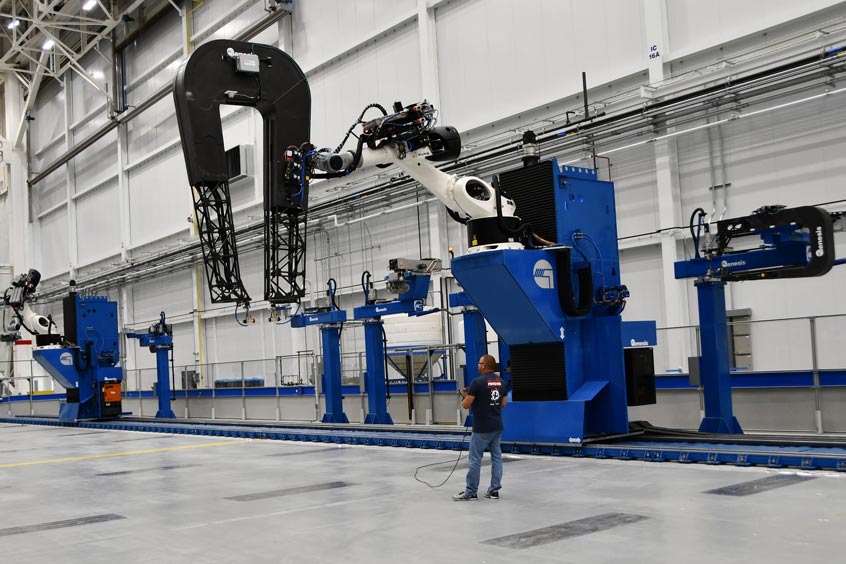
Photo: Press release
An ultrasonic-equipped robot arm inspects aerospace structures at Spirit AeroSystems.
Artificial intelligence (AI) is helping industry move faster, safer and smarter. A research collaboration among Spirit AeroSystems Inc., the U.S. Department of Energy’s (DOE’s) Argonne National Laboratory, Northern Illinois University (NIU) and Texas Research Institute (TRI) Austin has developed a powerful, new AI-assisted tool that transforms how manufacturers inspect critical aerospace components.
The technology uses AI to quickly spot parts of ultrasonic scan data that may need a closer look. The AI tool uses a type of supervised machine learning model called a convolutional neural network — which is especially good at recognizing patterns in images — trained on thousands of Spirit’s annotated ultrasonic scans and carefully tuned to accurately detect important defects without missing any or raising too many false alarms. The tool’s accuracy was confirmed by comparing its results to data that had already been reviewed by expert human inspectors.
The AI tool helps trained inspectors work more efficiently by highlighting areas in the ultrasonic scan that are most likely to have problems, allowing inspectors to focus their review on those areas instead of going through the entire dataset. That saves time and improves how efficiently they work. This is especially helpful when checking composite materials, which are more common in airplanes and take a lot of work to inspect.
This project brought together diverse expertise from across sectors. Spirit’s deep knowledge in ultrasonic inspection procedures, characteristics of defects, production workflows and real-world constraints ensured the model was trained and evaluated on realistic, relevant data aligned with manufacturing standards. Argonne led the development and training of the AI model using its high performance computing resources. NIU contributed to AI model refinement and performance validation, and TRI Austin led the software integration effort and brought prior experience in ultrasonic inspection automation.
“This project represents a major step forward in automating quality assurance in composite manufacturing,” said Zachary Kral, NDI R&T Engineer at Spirit AeroSystems. “The collaborative approach allowed us to combine Spirit’s domain knowledge with Argonne’s AI expertise. Contributions from NIU and TRI Austin strengthened the solution’s robustness and applicability.”
Using powerful computers at the Argonne Leadership Computing Facility, a DOE Office of Science user facility, the team trained the AI tool to be both accurate and reliable. In early use, the tool cut inspection time by 7% compared to current human inspection time, all while meeting strict safety and performance standards. In conventional practice, ultrasonic inspection of composite structures requires significant manual effort with inspectors visually reviewing large datasets to identify and characterize potential defects.
The tool also saved about 3% in energy at the facility level for each aircraft by shortening the overall production flow time. This decreases the amount of time that production systems, inspection equipment, factory lighting, HVAC and support infrastructure are being used.
“By combining AI with advanced computing resources, we helped deliver a solution that is both practical and scalable,” said Rajkumar Kettimuthu, senior scientist and group leader at Argonne. “This model was designed to generalize across different geometries and material systems, and its integration into a portable inspection tool enables adaption to other aircraft inspection programs with minimal retraining.”
Now in the process of being deployed across all ultrasonic inspections of the forward fuselage section of an active commercial aircraft program at Spirit, the AI tool was tested on ultrasonic scans from other composite parts showing it can be generalized to other components provided the necessary training data is available. This project illustrates how AI and high-performance computing can deliver practical solutions in complex industrial environments. It also highlights the growing role of national labs like Argonne in helping U.S. industry improve performance while reducing costs and energy use.
“This effort demonstrates what’s possible when we bring together capabilities from different sectors,” said Ian Foster, director of the Data Science and Learning division at Argonne. “It’s a blueprint for accelerating innovation and generating value for both industry and the scientific community.”
While the inspection data remain proprietary to Spirit AeroSystems, the underlying AI techniques are being made available for academic research and may be licensed for commercial use — supporting broader innovation and economic growth across sectors.
This research was supported by DOE’s Office of Science and Office of Energy Efficiency and Renewable Energy.
| Contact details from our directory: | |
| Spirit AeroSystems, Inc. | Wing Flaps, Empennages, Certification Services, Nacelles, Engineering Design Services, Wings, Aircraft Control Surfaces, Aircraft Structural Components, Thrust Reversers, Engine Pylons, Fuselage Sections, Engine Inlets, Wing Spoilers, Fairings, Machining Services, Metal & Alloy Fabrications |
| Related directory sectors: |
| Test Services |

Weekly news by email:
See the latest Bulletin, and sign up free‑of‑charge for future editions.
Garmin launches G2000 PRIME avionics suite
Sikorsky eyes Europe for NGRC manufacturing

Crane A&E brake system joins Phantom 3500 program