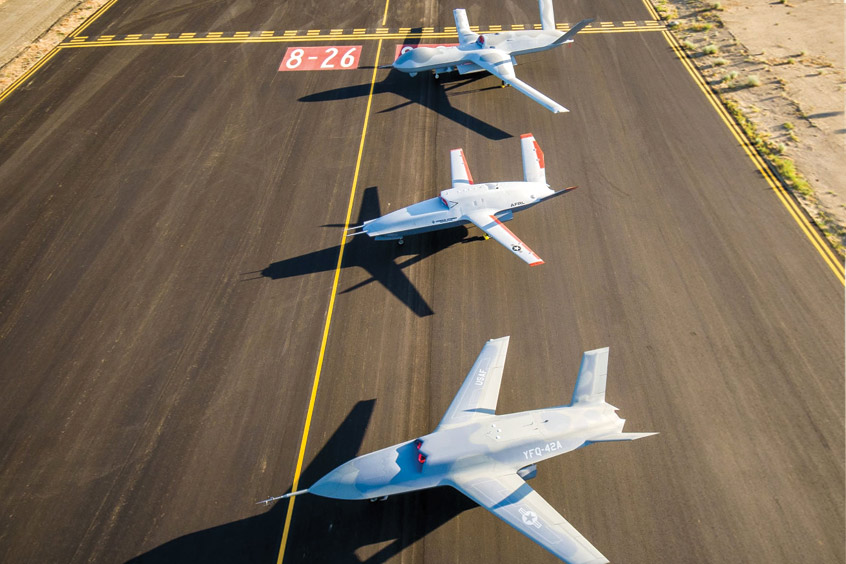
Photo: GA-ASI
General Atomics Aeronautical Systems unmanned jets include the MQ-20 Avenger, XQ-67A and YFQ-42A.
AFRL’s XQ-67A, a second-generation Autonomous Collaborative Platform, has completed a test flight in the California High Desert that demonstrated the integration of government reference autonomy with tactical datalink communications.
The test allowed the aircraft to receive real-time updates and situational awareness through a tactical datalink, enabling coordination with both crewed and uncrewed systems. It also validated multiple onboard mission systems, including autonomy, computing, networking, power and thermal management.
Built by General Atomics Aeronautical Systems under contract with AFRL, the XQ-67A forms part of the platform-sharing approach towards achieving scalable affordable mass. The platform supports AFRL goals of modularity and integrated teaming across future operations.
Mike Atwood, General Atomics’ vice president of advanced programmes, says: “This successful test underscores the Department’s commitment to fielding autonomous systems that can integrate into joint operations using existing tactical networks. Government owned autonomy on the XQ-67A is a concrete step toward deployable, combat-relevant autonomy that works with and alongside crewed platforms.”
AFRL believes the testbed accelerates technology transition and advances its objectives for future autonomous integration.
| Contact details from our directory: | |
| General Atomics Aeronautical Systems (GA-ASI) | Airframer |
| Air Force Research Laboratory (AFRL) | Research/Consulting Services, Technical/Eng/Scientific Studies, Wind Tunnels |
| Related aircraft programs: |
| General Atomics Gambit Series |

Weekly news by email:
See the latest Bulletin, and sign up free‑of‑charge for future editions.
HAL and Safran finalise Aravalli engine deal

JetZero raises $100m as Z4 nears flight test
Bombardier acquires MHI Canada Aerospace assets