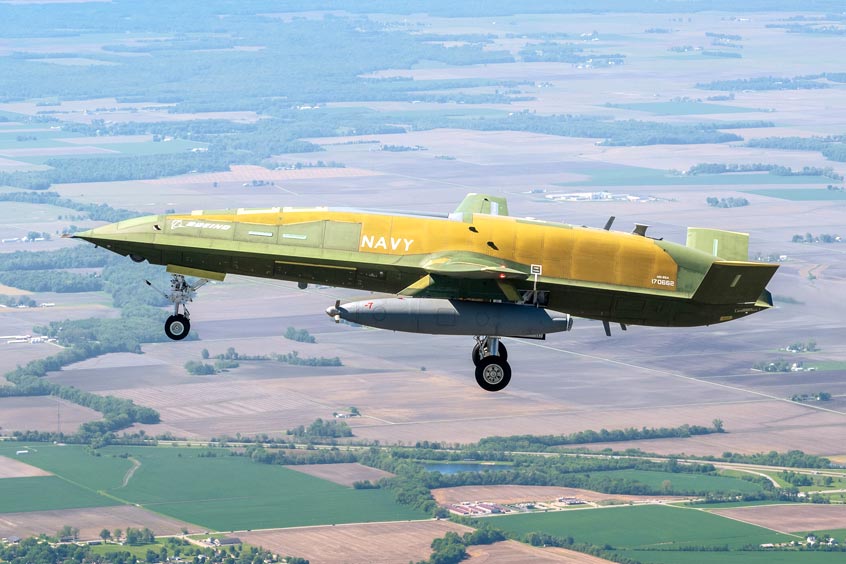
Photo: Boeing / Eric Shindelbower
The MQ-25A is intended to provide carrier-based aerial refuelling, significantly extending the operational range of the carrier air wing.
Boeing and the U.S. Navy have completed the first test flight of an operational MQ-25A Stingray, marking a step toward aircraft carrier operations and unmanned integration on the carrier deck.
The two-hour flight took place from MidAmerica St. Louis Airport in Mascoutah, Illinois, where the programme is based. The aircraft autonomously taxied, took off, flew, landed and responded to commands from the Unmanned Carrier Aviation Mission Control System MD-5 Ground Control Station.
Boeing and U.S. Navy Air Vehicle Pilots facilitated the mission by sending aircraft commands from the GCS and monitoring its performance. Once airborne, the Stingray executed a pre-determined mission plan that validated its flight controls, navigation, Rolls-Royce AE 3007N engine integration and safe integration with the ground control station.
The MQ-25A is intended to provide carrier-based aerial refuelling, significantly extending the operational range of the carrier air wing. The capability will allow F/A-18 Super Hornets currently performing the aerial refuelling role to focus on their primary role as multi-role strike fighters. The platform is also equipped for intelligence, surveillance and reconnaissance missions.
“Today's successful flight builds on years of learning from our MQ-25A T1 prototype and represents a major maturation of the program,” says Dan Gillian, vice president and general manager, Boeing Air Dominance. “The MQ-25A is the most complex autonomous system ever developed for the carrier environment, and this historic achievement advances us closer to safely integrating the Stingray into the carrier air wing.”
“The first flight of the MQ-25A is a landmark achievement for the Navy-Boeing team and a critical step toward the future of the carrier air wing,” adds Rear Admiral Tony Rossi, who oversees the Program Executive Office for Unmanned Aviation and Strike Weapons. “This flight demonstrates our progress in delivering a carrier-based refueling capability that will significantly extend the reach and lethality of our fleet.”
Rolls-Royce says the aircraft’s AE 3007N engine has a high-bypass-ratio architecture designed to support low specific fuel consumption for long-endurance missions. The company expects to deliver four more AE 3007N engines to Boeing in 2026 to support production spares.
Boeing and the Navy will conduct additional test flights at MidAmerica St. Louis Airport before moving the aircraft to Naval Air Station Patuxent River in Maryland for carrier qualification preparations.
| Contact details from our directory: | |
| Rolls-Royce North America Inc. | Turbofan Engines, Turbojet Engines, Turboshaft Engines |
| Boeing Defense, Space & Security | Airframer |
| NAVAIR Naval Air Systems Command | Research/Consulting Services |
| Related aircraft programs: |
| Boeing MQ-25 Stingray |
| Related directory sectors: |
| Turbine Engines |

Weekly news by email:
See the latest Bulletin, and sign up free‑of‑charge for future editions.
Albany will continue manufacturing 787 fuselage frames

Pratt & Whitney invests $25 million in Poland
GE Aerospace buys Cleveland-based castings maker CPP
B-N completes first Islander assembled in UK from component level