PRESS RELEASE
Issued by: TU Delft Faculty of Aerospace Engineering
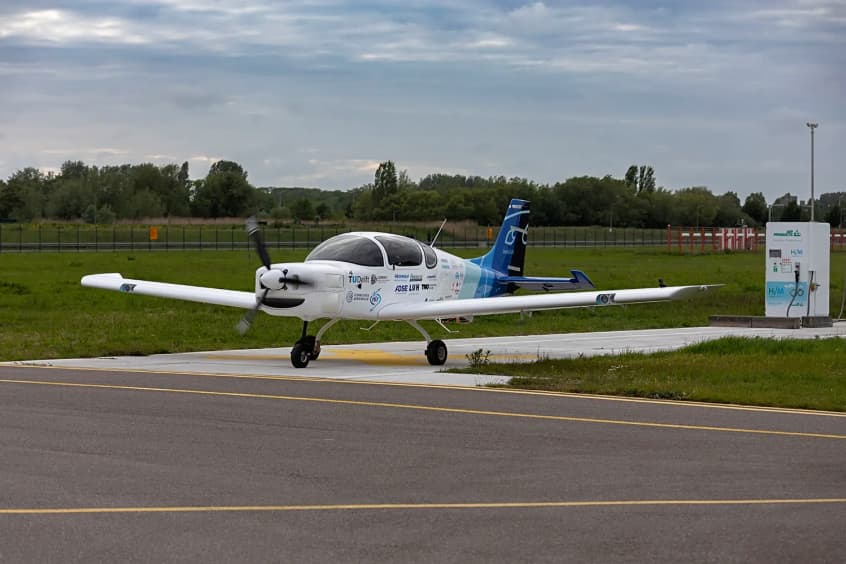
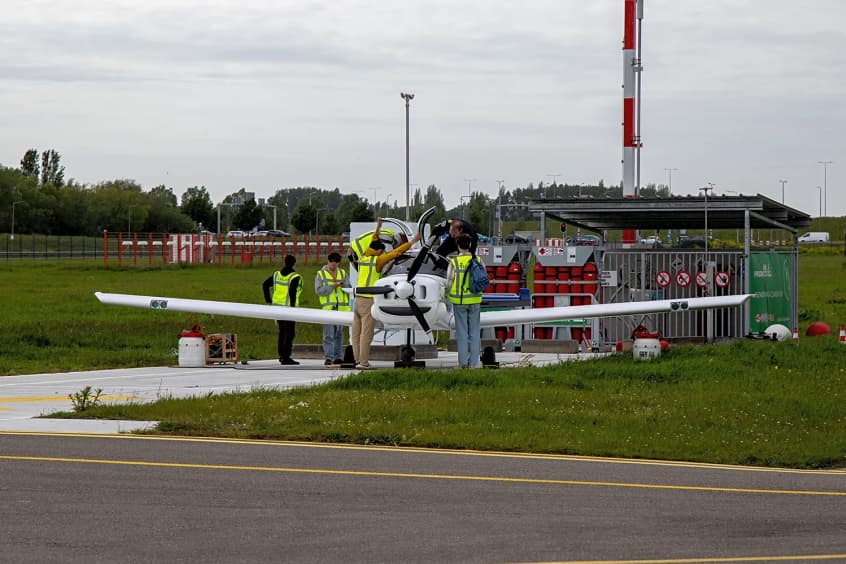
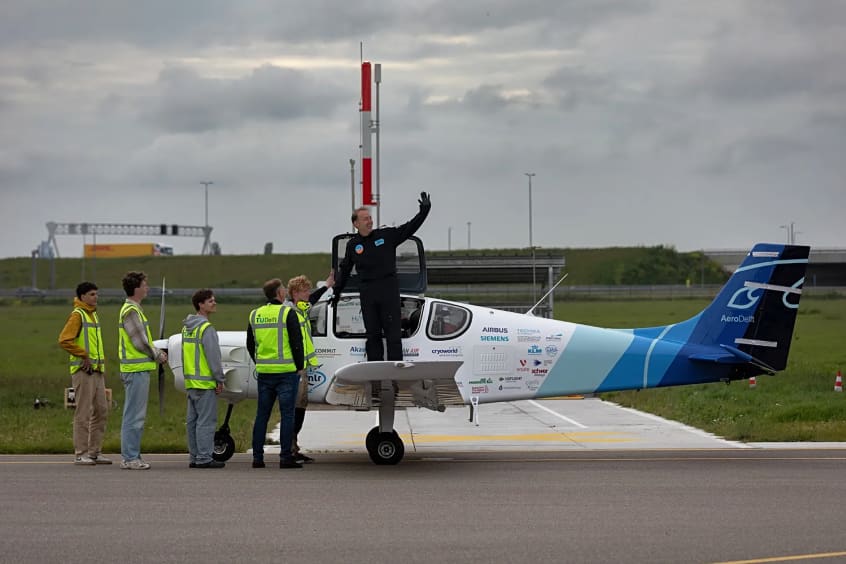
A first this week for the Delft-based student team AeroDelft and their partners. They carried out the very first taxi tests with a hydrogen aircraft at an operational airport in the Netherlands. The ground tests at Rotterdam The Hague Airport, including refuelling, tests of the aircraft's propulsion system and the first taxi run, provide essential experience for the development of hydrogen infrastructure at airports and, of course, for the hydrogen technology that AeroDelft is applying in their aircraft. Team manager Isha Moharir: "We want to demonstrate that flying on hydrogen works and that it's safe in the air and at the airport."
Refuelling, testing and taxiing
The Delft-based student team, AeroDelft, is designing and building a 1-seater aircraft powered by liquid hydrogen. This week, they reached an important milestone: they successfully tested their hydrogen-powered aircraft at Rotterdam The Hague Airport. Team manager Isha Moharir: "We carried out various ground tests with gaseous hydrogen; for instance, we were able to refuel with hydrogen at the airport, test our aircraft's propulsion system and, for the first time, taxi the aircraft at an operational airport." The ground tests form part of a wider project involving partners Rotterdam The Hague Airport, Air Products and TU Delft, coordinated by the Rotterdam The Hague Innovation Airport Foundation (RHIA), aimed at establishing and testing a hydrogen value chain at the airport.
"This successful series of taxi tests shows that we are moving step by step closer to the aviation of the future. They mark an important next step towards a more sustainable aviation sector. Rotterdam The Hague Airport is a testing ground for innovation, where we bring partners together and provide space to test new solutions in practice. It is precisely by testing at an operational airport that we learn what is really needed to make hydrogen-powered aviation safe and scalable." - Daan van Dijk, Innovator at Rotterdam The Hague Airport
From the lab to the airport
These tests are an essential and logical step towards developing hydrogen-powered flight. Moharir: "We have a step-by-step approach. We have already carried out several tests. Initially, these focused mainly on the various subsystems. Last year, we successfully tested our entire powertrain running on liquid hydrogen in a laboratory setting. Now we have been able to test the propulsion system in a real aircraft at a real airport. This time we worked with gaseous hydrogen, because that's a more developed technology at the moment. That is a major step in scaling up the technology." Testing at a real and operational airport also yields incredibly valuable insights into safety. Together with partners, including Research Test Pilots Alexander in 't Veld and Hans Mulder and their team from the TU Delft Flight Test Laboratory, based at RTHA in Fieldlab Next Aviation, the team has carried out risk analyses and drawn up an operational taxi test plan, enabling the team to conduct the tests safely at the airport. Moharir: "We are making absolutely no concessions on safety."
AeroDelft's aim is to have the aircraft flying on liquid hydrogen within a few years. The next step for the team is to work on a safe, suitable storage tank and distribution system for liquid hydrogen in the aircraft. The current aircraft is expected to remain airborne for 40 minutes on a full tank of gaseous hydrogen. As the energy density of liquid hydrogen is much higher, the aircraft is expected to remain airborne for two hours on liquid hydrogen in a few years' time. Isha concludes: "This is how we are moving step by step towards sustainable aviation, always asking ourselves: how will this work at a real operational commercial airport? That is why this test, carried out on an operational airport, is so important to us."
DutcH₂ Aviation Hub
These ground tests are part of the DTB- DutcH₂ Aviation Hub project (infrastructure phase 1), which is subsidised by the City of Rotterdam. Within the DutcH₂ Aviation Hub programme, partners such as AeroDelft, RTHA, Air Products, and TU Delft collaborate on the development, testing, and scaling up of hydrogen-powered aviation across the entire chain, with RTHA serving as a fieldlab. The DutcH₂ Aviation Hub is part of the RHIA Foundation, which coordinates this project. In 't Veld and Mulder from TU Delft are the test pilots performing the taxi tests.
| Contact details from our directory: | |
| TU Delft Faculty of Aerospace Engineering | Research/Consulting Services, Technical/Eng/Scientific Studies, Airframer |
| AeroDelft | Airframer |
| Air Products & Chemicals, Inc. | Fuel Tanks & Systems |
| Related aircraft programs: |
| AeroDelft Project Phoenix |

Weekly news by email:
See the latest Bulletin, and sign up free‑of‑charge for future editions.
CubCrafters secures EASA approval for 215 HP XCub
Airbus expands Belfast wing plant ahead of A220 production increase
GKN displays UAV demonstrator and engine