PRESS RELEASE
Issued by: Ascendance
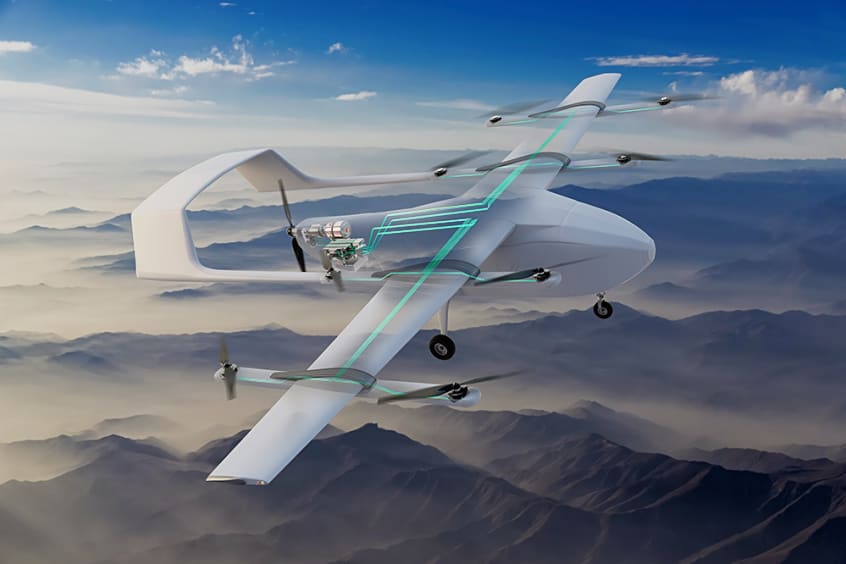
Photo: Ascendance
At Eurosatory 2026, Ascendance confirms its positioning as an industrial defence player and accelerates the deployment of its sovereign hybrid-electric propulsion.
Already proven in flight, supported by defence programs and leading industrial partners, STERNA solution addresses the new capability requirements of the armed forces in terms of endurance, stealth, logistical autonomy and operational resilience. With more than €60M raised, 82 patents and the support of France 2030 for the industrialisation of its technologies, Ascendance marks a new milestone in its development with the ambition of building in France a reference production capability in the service of European industrial and technological sovereignty.
STERNA for Defence: a new generation of hybrid-electric propulsion for the operational superiority of the forces
Recent conflicts have profoundly transformed the operational requirements of the armed forces. Beyond platform performance, the ability to operate for longer, more discreetly and with reduced logistical dependency is becoming a decisive factor of operational superiority. In this context, hybridisation opens a new era: that of aerial systems capable of increasing their endurance, extending their range and adapting to the pace of operations.
Developed since 2018 by Ascendance, STERNA combines thermal and electric propulsion within a modular architecture and meets the needs of multiple categories of military drones, from tactical intelligence and surveillance platforms to heavy-cargo transport drones, through to MALE (Medium Altitude Long Endurance) systems operating on long-endurance, long-range missions.
Increased endurance
Up to four times higher than that of a full-electric drone and up to 40% longer than that of a thermal drone, thanks to intelligent management of onboard energy. The electric boost at take-off enables the use of a more appropriately sized thermal engine for cruising phases, generating this performance gain. Moreover, the electric boost also confers a Short Take-Off and Landing (STOL) capability.
Enhanced stealth
Reduction of acoustic and thermal signatures as a major operational lever. Effective management signature helps reduce the platform's detectability in contested environments. The hybrid architecture also enables fully electric, and therefore silent flight phases on segments where stealth is critical.
Enhanced operational flexibility
By reducing dependence on ground charging infrastructure and optimising the use of onboard energy, hybrid-electric propulsion facilitates system deployment, reduces logistical constraints and improves fleet availability rates.
An open, modular and interoperable architecture
Built on an open-architecture design approach, STERNA integrates with different types of platforms without requiring major overhaul of existing systems. This modularity promotes interoperability with mission architectures, logistics chains and command systems deployed by the armed forces, while reducing integration costs and timescales.
"In a contested environment, operating for longer and remaining stealthy provides the operational capabilities needed to win. Technological sovereignty rests on mastery of critical capabilities." General Philippe Lavigne on the operational reading of hybridisation
A technology already proven and adopted by defence players
Ascendance today holds concrete references that attest to the maturity of its technology and its suitability to the needs of the defence sector. The STERNA hybrid-electric propulsion has notably been integrated on the Delair DT46 drone as part of a program conducted with the support of the French Procurement Agency (DGA – Missile Testing). Ascendance is today working on several defence programs covering the heavy logistics drone, MALE platform and tactical drone segments. The company has already signed several contracts in this field, confirming the operational and economic relevance of its product.
These achievements illustrate Ascendance's transition to an industrial and commercial deployment phase, in the service of European defence markets. Ascendance has established its Defence Board to support its acceleration. To support this acceleration, Ascendance is strengthening its governance and defence expertise. The company announces the formation of a Military Board bringing together high-level profiles from the operational, industrial, and technological worlds.
This board includes:
– General Philippe Lavigne, former Supreme Allied Commander Transformation of NATO and Chief of Staff of the French Air and Space Force.
– Andreas Löwenstein, former EVP Airbus Helicopters and former EVP Strategy & Innovation of Naval Group, former CEO of Kopter Group AG, investor and Ascendance board member.
– Pierre Duval, recognised expert in international development in the defence sector, with extensive experience serving numerous major French military programs in the aeronautical field.
Furthermore, Ascendance also benefits from the support of General Denis Mercier, former Chief of Staff of the French Air Force and former Supreme Allied Commander Transformation of NATO, today a board member of Helsing, who contributes to the company's strategic thinking on defence and innovation challenges. This approach also relies on a dedicated internal team, bringing together Ascendance's technical, commercial and strategic expertise around the development of STERNA for Defence and its applications for unmanned aerial systems.
From technology to production: an industrial capability already under construction
Ascendance is now entering industrial scale-up. Supported in particular to the tune of €12.2M under the France 2030 – First Factory program, the company is developing in Muret, Occitanie, its first production capability dedicated to hybrid-electric systems. This ramp-up is built on advanced industrial processes, a full-scale test bench with more than 1,000 hours of tests and an industrial roadmap designed to meet the growing needs of civil and defence markets. Ascendance's ambition is to contribute to the emergence in France of a sovereign industry capable of designing, producing and maintaining hybrid propulsion systems for strategic aerial applications.
"The armed forces are today seeking solutions capable of increasing their endurance, autonomy and resilience without adding to their logistical footprint. Hybridisation provides a concrete answer to these challenges. With STERNA, we now have a sovereign technology supported by reference clients and engaged in an industrialisation dynamic. Our ambition is to bring to life in Europe a leading player in hybrid propulsion for defence applications." Jean-Christophe Lambert, co-founder and CEO of Ascendance.
| Contact details from our directory: | |
| Ascendance | Airframer |
| Related aircraft programs: |
| Delair DT46 Series |
| Ascendance Flight Technologies ATEA |
| Related directory sectors: |
| Electric Propulsion |

Weekly news by email:
See the latest Bulletin, and sign up free‑of‑charge for future editions.
Textron and Merlin unveil pilot-optional SkyCourier concept

G2E consortium wins 18-month GCAP electronics contract
GE advances XA102 adaptive cycle engine