Moving critical cargo by air only creates value if the aircraft can carry meaningful payloads over relevant distances. Combining vertical takeoff and landing, long-range endurance, and practical payload capacity in a single platform remains one of the industry's greatest challenges.
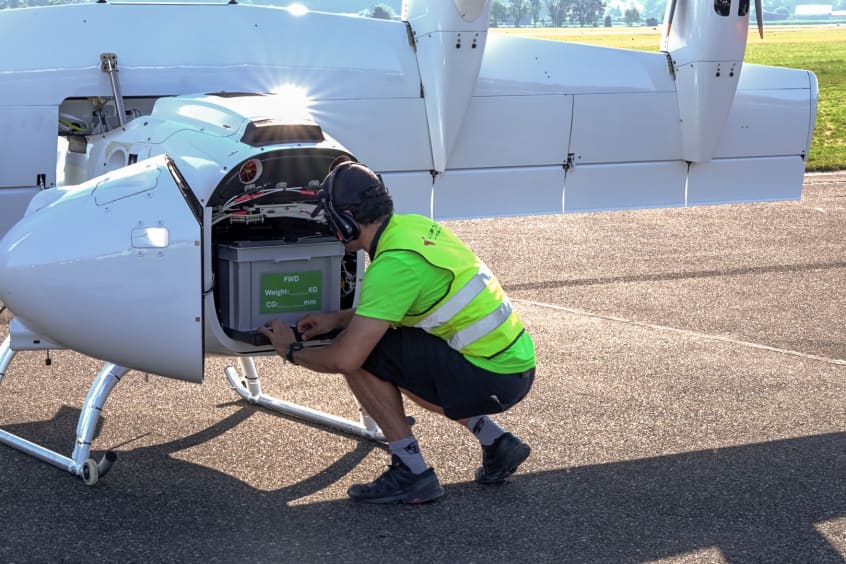
Dufour Aerospace has now demonstrated that capability by conducting a 20 kg payload, 200 km range flight campaign in its Zurich-based test facility, validating various improvements to the propulsion system and aircraft structure. While productionisation efforts on the series aircraft are finalising, this performance enables operators to support critical cargo operations, including medical resupply, industrial spare parts delivery, emergency response, and the transport of high-value equipment. It also marks an important step in validating the operational capability required for future commercial deployment.
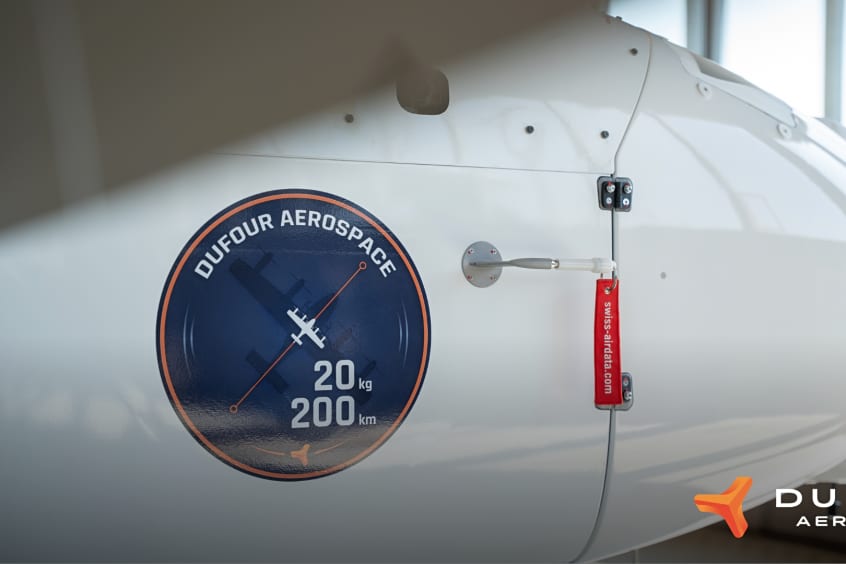
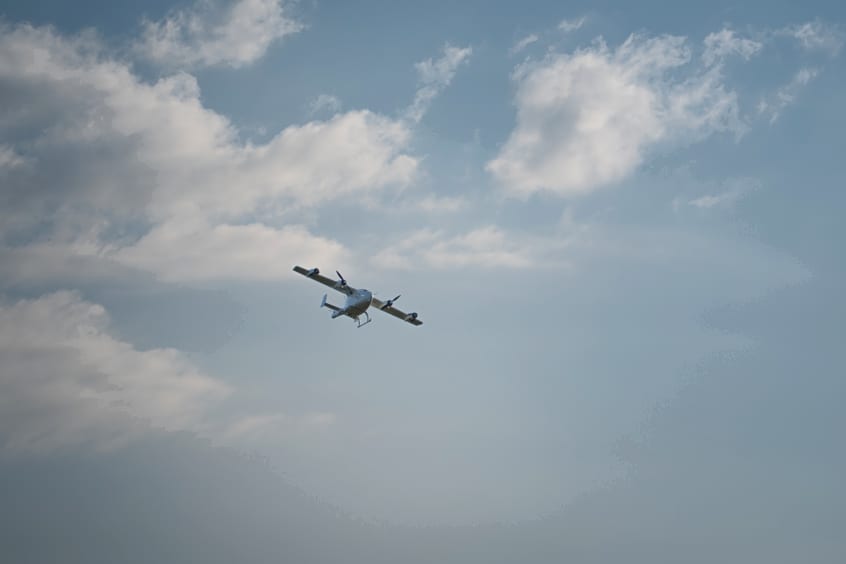
The Aero-200 is the first civilian hybrid-electric tilt-wing eVTOL platform to achieve this milestone. During various missions from Dübendorf Airfield, the flight campaign demonstrated the range, endurance, and payload capability required for long-range logistics missions where conventional transport is constrained by time, distance, or infrastructure. The Aero-200 configuration allows for an operation of 200 km with a payload of 20 kg at sea level in 33°C temperature.
"This flight campaign illustrates the profound potential the Aero-200 has for long-range missions carrying critical cargo or high-value sensors," said Timon Wehmann, Chief Engineer at Dufour Aerospace. "For a vertical takeoff and landing drone in this category, navigating this distance while maintaining flawless stability throughout continuous manoeuvring is a remarkable achievement. We are very pleased with the results, and I am especially pleased that we were able to validate the team's hard work."
From Performance to Operational Capability
The Aero-200 was developed to solve real logistics challenges rather than achieve isolated performance figures. Its hybrid-electric tilt-wing architecture combines the flexibility of vertical takeoff and landing with the aerodynamic efficiency of wing-borne flight, allowing operators to conduct long-range missions without relying on conventional runway infrastructure.
This opens the door to applications including:
– Medical resupply and healthcare logistics
– Time-critical industrial spare parts delivery
– Emergency response and disaster relief
– Logistics support for remote communities and infrastructure
– Transport of high-value equipment and sensors
The successful completion of this campaign demonstrates that the Aero-200 can combine the range, payload, and endurance required to make these operations commercially viable.
Building a Commercial Uncrewed Aerial System
Commercial drone logistics depends on far more than aircraft performance. It requires a complete operational ecosystem that enables platforms to be managed safely, integrated into existing operations, and deployed at scale.
Alongside expanding the Aero-200's flight envelope, Dufour Aerospace continues to invest in the operational capabilities needed to support scalable long-range logistics, including operator interfaces, contingency management and robustness of flight operations.
Recent milestones have shown that progress extends well beyond the aircraft itself. Earlier this year, Dufour Aerospace successfully conducted guidance flights in Sweden, with the aircraft controlled entirely from its Remote Control Room (RCR) in Dübendorf, Switzerland. The demonstration validated a key operational capability by separating the platform's operating area from the operator's location, an essential step toward routine BVLOS drone operations.
These developments build on the company's broader remote operations strategy aiming at establishing the operational framework needed to support commercial drone logistics at scale.
Together, these achievements demonstrate the steady maturation of the Aero-200 programme, from validating individual technologies to proving the aircraft, operational concepts, and supporting infrastructure required for commercial deployment.
Advancing Toward Commercial Deployment
The successful 20 kg payload, 200 km range flight campaign represents another significant step toward bringing the Aero-200 into operational service. Each phase of testing moves beyond validating individual technologies and closer to demonstrating a complete logistics solution capable of supporting real customer missions.
"It took a great deal of foundational work to master the aerodynamic behaviour, develop our customised flight control hardware and software, and establish our development pipeline," said Sascha Hardegger, CEO of Dufour Aerospace. "Now we are rapidly approaching the production configuration of the Aero-200. The team and the development pipeline we have built enable us to bring the Aero-200 and future, bigger products to market, providing a major competitive advantage."
| Contact details from our directory: | |
| Dufour Aerospace | Airframer |
| Related aircraft programs: |
| Dufour Aero-200 |

Weekly news by email:
See the latest Bulletin, and sign up free‑of‑charge for future editions.
CubCrafters secures EASA approval for 215 HP XCub

Airbus expands Belfast wing plant ahead of A220 production increase
GKN displays UAV demonstrator and engine