PRESS RELEASE
Issued by: Korea Aerospace Industries Ltd.
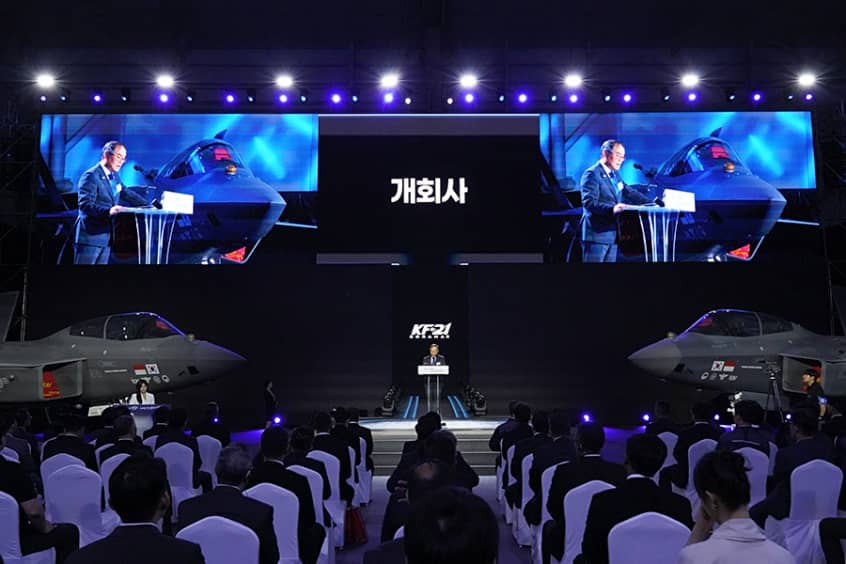
Photo: KAI
The KF-21 'Boramae,' South Korea's first domestically developed supersonic fighter jet, has successfully concluded its system development phase, spanning approximately ten years, marking a new milestone for the nation's aerospace industry.
Korea Aerospace Industries (KAI) announced on the 29th that it held a ceremony marking the completion of the KF-21 system development at its headquarters in Sacheon, South Gyeongsang Province, under the supervision of the Defense Acquisition Program Administration (DAPA).
Approximately 300 people attended the event, including DAPA Commissioner Lee Yong-cheol; officials from the Ministry of National Defense, the Air Force, KAI, and partner companies; representatives from Indonesia's Ministry of Defense and PTDI (the international co-development partner); and officials from Lockheed Martin (the technical cooperation partner).
Attendees celebrated the success of the decade-long system development project and commended the hard work of the industry, research, government, and military personnel involved. The event also served as an opportunity to reflect on the achievements of the partnership with Indonesia and to further solidify future cooperation.
The conclusion of system development is regarded as a pivotal turning point that not only secures a core fighter jet for the Republic of Korea Air Force but also elevates the competitiveness of the nation's aerospace industry and the global standing of the "K-Defense" sector.
From development to mass production: ushering in the era of South Korea's indigenous fighter jet
Since the launch of system development in 2015, the KF-21 has successfully undergone preliminary and detailed design, prototype manufacturing, and ground and flight testing, meeting all required performance and safety standards.
Notably, by successfully completing the development of an integrated system, encompassing not only the aircraft itself but also Integrated Logistics Support (ILS) and training systems, the project has secured independent, full-lifecycle capabilities spanning development, production, operation, maintenance, and training.
Following the rollout of the first mass-produced unit last March, the conclusion of system development marks the KF-21 programme's entry into the full-scale mass production and deployment phase.
Through this achievement, South Korea has established itself as the world's eighth nation to develop a supersonic fighter jet and possesses an independent mass-production system, thereby laying the foundation for advanced air power capable of addressing future security environments.
A cornerstone for self-reliant defence and the future aerospace industry
Capabilities accumulated during the KF-21 development process, including system integration, AESA radar, advanced avionics, flight control, and structural design and manufacturing technologies, are expected to serve as core assets for South Korea's future air power.
Furthermore, the aerospace industry ecosystem established in collaboration with approximately 500 domestic partner companies has contributed to the localisation of core technologies, enhanced partner competitiveness, and the creation of high-quality jobs; this ecosystem is expected to further boost the competitiveness of the "K-Defense" sector through expanded mass production and exports.
Eom Dong-hwan, Commissioner of the Defense Acquisition Program Administration (DAPA), stated, "The success of the KF-21 is a magnificent achievement made possible by the blood and sweat of project stakeholders and the technical teams involved, as well as the support of the entire nation, which believed in and cheered for our technological prowess." He added, "True to the event's slogan—'Success Achieved Together, a Great Soar Toward the Future'—we will promote the excellence of the KF-21 and once again demonstrate South Korea's strength through self-reliant defense based on technological independence."
Leaping forward as a future aerospace powerhouse… KAI takes the lead
Leveraging the technological expertise and production capabilities secured through the KF-21 system development, KAI plans to drive successful mass production and ensure the stable deployment of the aircraft to the Air Force, while also playing a pivotal role in realising the government's vision of becoming one of the world's top four defense industry powers.
Moving forward, the company intends to continuously pursue performance upgrades and the development of future air power capabilities to enhance the competitiveness of South Korea's aerospace industry and further strengthen the global standing of the K-Defense sector.
KAI President Kim Jong-chul stated, "The successful system development of the KF-21 is a historic achievement that has demonstrated to the world South Korea's capability to develop advanced fighter jets using its own indigenous technology." He added, "KAI will lead the nation's leap into a global aerospace powerhouse by not only ensuring successful mass production and stable deployment but also by continuously advancing the platform, through system integration with domestically developed weaponry, performance upgrades, and the development of AI-linked next-generation air combat systems and Manned-Unmanned Teaming (MUM-T) capabilities."
| Contact details from our directory: | |
| Korea Aerospace Industries Ltd. | Airframer |
| Lockheed Martin Corporation | |
| PT Dirgantara Indonesia - Indonesian Aerospace | Airframer |
| Related aircraft programs: |
| KAI KF-21 Boramae |

Weekly news by email:
See the latest Bulletin, and sign up free‑of‑charge for future editions.
Textron and Merlin unveil pilot-optional SkyCourier concept

G2E consortium wins 18-month GCAP electronics contract
GE advances XA102 adaptive cycle engine