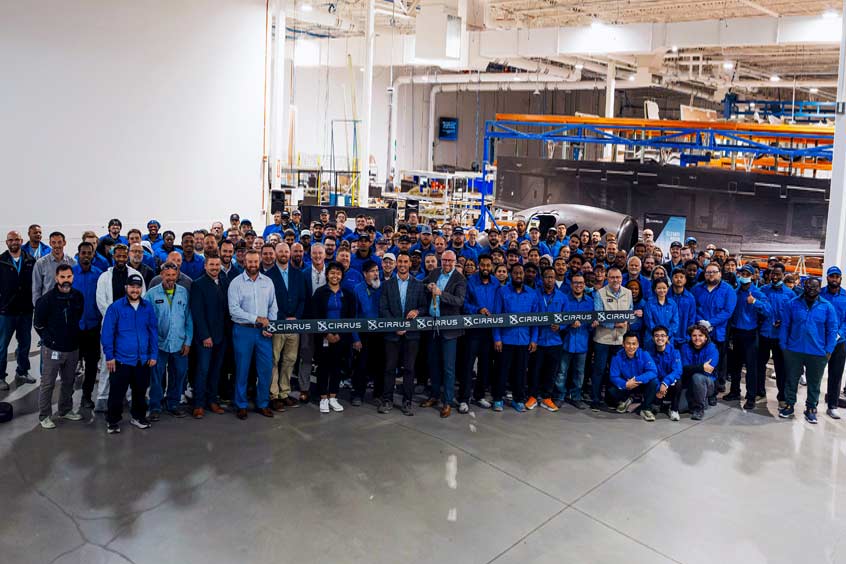
North Wind today highlighted its central engineering role in NASA's new Flight Dynamics Research Facility (FDRF) following a last week's ribbon-cutting ceremony at NASA's Langley Research Center. The 25,000-square-foot FDRF is NASA's first major wind tunnel built in more than 40 years.
As the specialized wind-tunnel engineering partner on the facility's design-build team, North Wind was responsible for the core systems that turned the building into a fully operational flight research facility: the flow circuit that directs airflow, the fans that generate aerodynamic power, and the controls that coordinate the facility's operation.
Working alongside prime design-build contractor BL Harbert International and architecture and engineering partner Mason & Hanger, North Wind helped translate NASA's demanding performance requirements including airflow speed and quality, temperature control and testing flexibility into an integrated, operational wind-tunnel system.
"North Wind's role in the Flight Dynamics Research Facility builds on decades of experience designing and engineering sophisticated wind tunnels for the nation's most demanding research programmes," said Ryan Leo, executive vice president of North Wind's Design/Build Division. "That expertise helped translate NASA's ambitious requirements into an advanced facility that will expand the boundaries of flight research well into the future."
The project began under Calspan Aero Systems Engineering, whose team and capabilities became part of North Wind when the company was formed in May 2024. The approximately $43.2 million design-build contract was awarded to BL Harbert International in late 2021. North Wind was not the prime construction contractor; its role centred on the specialised systems that enable the facility to operate as a wind tunnel.
The vertical tunnel combines and expands the capabilities of Langley's historic 12-Foot Low-Speed Tunnel and 20-Foot Vertical Spin Tunnel. It can support both captive-model and free-flight testing, including research involving aircraft spin and recovery, vehicle stability and control, autonomous aircraft, drones, X-planes, and entry descent and landing technologies for future space missions.
The FDRF will support NASA research across aeronautics, science and space exploration, providing a flexible environment for studying how flight vehicles behave under a wide range of conditions.
| Contact details from our directory: | |
| North Wind | Research/Consulting Services, Testing Services, Flight Testing |
| NASA Langley Research Center | Research/Consulting Services, Wind Tunnels, Testing Services |
| Calspan Aero Systems Engineering | Test Equipment, Acoustic Test Equipment, Fuel Test Equipment, Test Cells, Wind Tunnels, Test Stands, Data Acquisition Systems, Computer-aided Testing |
| Related directory sectors: |
| Test & Measurement Meters |
| Design |

Weekly news by email:
See the latest Bulletin, and sign up free‑of‑charge for future editions.
H2-Sling hydrogen aircraft readies for flight
Heart’s X1 becomes largest battery-powered aircraft flown
North Wind commences build of hypersonic testing facility