Photo: Honeywell Aerospace
Honeywell Aerospace today announced that its Brno engineering team participating in a consortium together with project partners successfully integrated individual subsystems of Project NEWBORN, funded by European Union through EU Clean Aviation Joint Undertaking, into a functional hydrogen power source capable of generating and supplying electrical energy for an aircraft.
Project NEWBORN, which launched in 2023, brings together a consortium of 18 companies from 10 European countries with the aim to develop an aerospace-qualified, megawatt-class hydrogen fuel-cell propulsion system. The successful integration of the hydrogen power source demonstrates significant progress towards this goal. The next step will be an integrated ground demonstration of the complete propulsion system, in which the hydrogen power source and batteries will supply electricity to an electric motor driving an aircraft propeller.
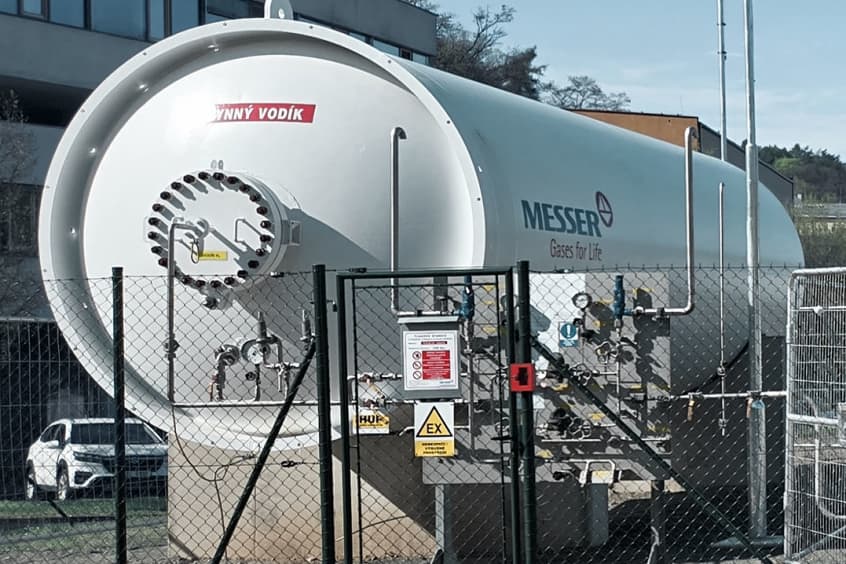
To test the hydrogen fuel-cell power source, Honeywell Aerospace developed a dedicated platform that can simulate a range of functions of an actual aircraft. The platform is currently installed and tested at the research and engineering facility operated by ÚJV Řež near Prague. It includes its own power source, working fluid distribution systems, electrical systems, a control room, safety equipment and heat rejection systems.
The engineering team completed the integration of the fuel cells with other subsystems and verified the functionality of the entire electrical power source. Tests also examined system leak tightness, operating parameters of the working fluids, interaction between the individual subsystems, control algorithms and protection mechanisms. Further testing will focus on expanding the power range and increasing the stability and resilience of the hydrogen power source.
Development on Project NEWBORN has taken place in parallel at several levels. While some teams design and manufacture hardware or develop software, others prepare models, simulations and integration studies. Alongside Honeywell Aerospace, companies including PowerCell, Fraunhofer and Test-Fuchs have made significant contributions to the development of individual parts of the electrical power source and related technologies. Teams focused on modelling, simulations and integration studies have also played an important role, including Siemens Industry Software, KU Leuven, Friedrich-Alexander-Universität Erlangen-Nürnberg and CIRA. Their work helped identify technical risks, validate design concepts and prepare the individual technologies for joint integration.
"Project NEWBORN is not only demonstrating new technology, it is demonstrating the ability of European industry, universities and research organisations to work together on ambitious technological visions and turn them into functioning systems," said Miroslav Matoušek, NEWBORN project coordinator, Honeywell Aerospace.
"A range of interconnected technologies have been developed in parallel within Project NEWBORN - from air supply and conditioning systems, hydrogen management and thermal management to electrical distribution, power electronics, control, communications and safety monitoring," said Ondřej Kotaba, technology fellow and NEWBORN technical lead with Honeywell Aerospace. "Bringing all these subsystems together into a single functional unit will represent the culmination of the project."
The hydrogen power source system will now be transferred to Gorizia, Italy, for the continuation of the project. Final tests in Gorizia will bring together dozens of technologies developed at different locations across Europe into a single functional unit: the fuel-cell power source will be connected to battery systems from Pipistrel and a megawatt-class electric propulsion system which was jointly developed by the University of Nottingham, Honeywell Aerospace and Pipistrel.
Project NEWBORN is working to create a single complete technology demonstrator, which would represent an important step towards the future development of hydrogen-electric propulsion. The final result will be one of the world's most powerful hydrogen-electric aircraft propulsion systems of its kind.
| Contact details from our directory: | |
| Honeywell Technology Solutions Research & Development Centre | Fuel Cells, Research/Consulting Services |
| PowerCell Sweden AB | Fuel Cells |
| Test-Fuchs GmbH | Test Equipment, Test Benches, Hydraulic Test Equipment, Pneumatic Test Equipment, Fuel Test Equipment, Fuel Pumps, Lubrication Pumps, Electric/Electronic Test Equipment, Brake System Components, Data Analysis, Test Stands |
| Siemens Industry Software NV | CIM Systems, Computer-aided Testing, Computer-aided Simulation, Data Acquisition Systems, Vibration Analysers |
| CIRA Centro Italiano Ricerche Aerospazia | Research/Consulting Services |
| University of Nottingham (IAT) | Research/Consulting Services, Academic Institutions |
| Pipistrel d.o.o. | Airframer |
| Related directory sectors: |
| Electrical Power Systems |
| Design |

Weekly news by email:
See the latest Bulletin, and sign up free‑of‑charge for future editions.
Textron and Merlin unveil pilot-optional SkyCourier concept

G2E consortium wins 18-month GCAP electronics contract
GE advances XA102 adaptive cycle engine