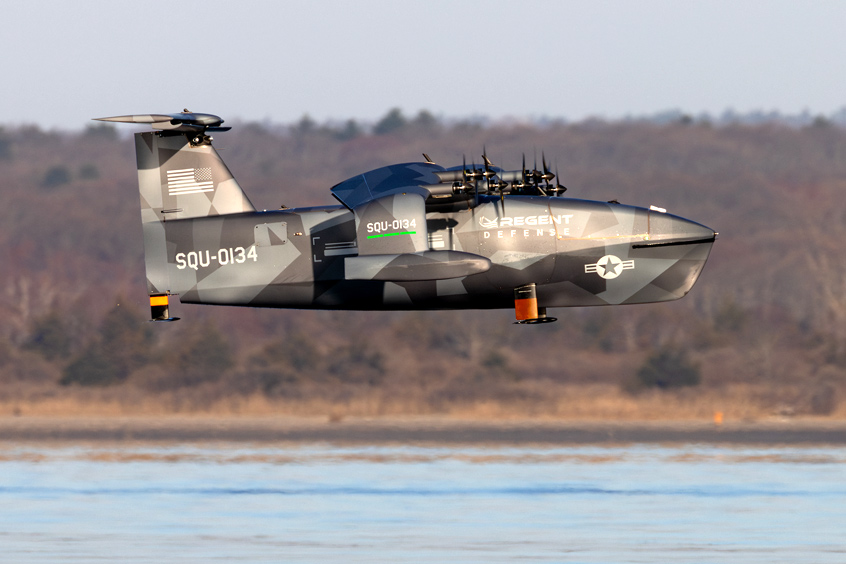
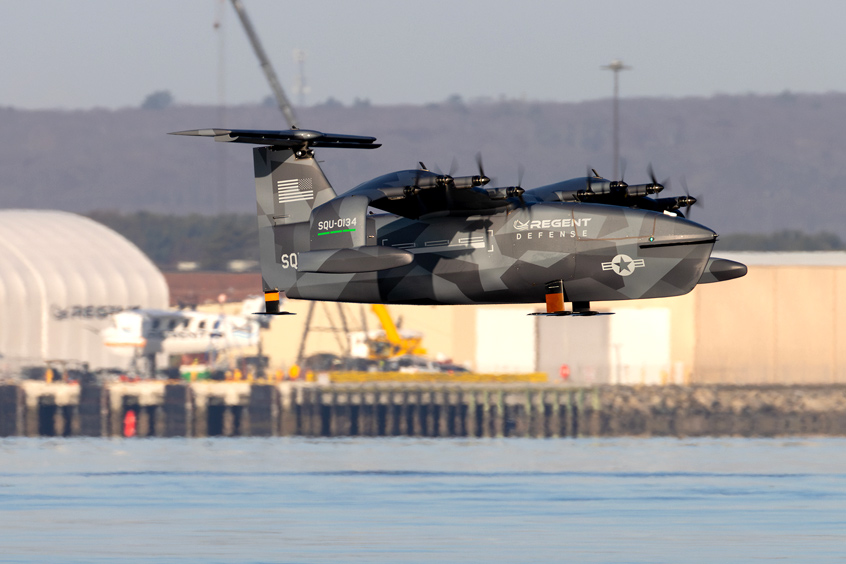
Regent has completed a ground-effect flight of its Squire autonomous Seaglider drone, designed for defence missions.
The flight is the first time a defence-specific wing-in-ground craft has flown in the United States and is part of Regent’s ongoing Squire test campaign. The company has focused development on defence uses as demand grows for new maritime capabilities.
“This successful flight milestone is a major success for our defense program and a strong signal of what Seaglider technology can deliver for the warfighter,” says Billy Thalheimer, co-founder and CEO of Regent. “There are no products in the market today that combine the speed and wave tolerance of Squire at such a compelling price point. This will revolutionize maritime warfare.”
Seaglider vessels fly close to the water using an air cushion, enabling efficient travel below radar. Squire is designed to reach speeds of up to 70 knots, with a range of more than 100 nautical miles and a payload of 50 pounds.
The platform is intended for missions including intelligence, surveillance and reconnaissance, logistics, search and rescue and anti-submarine warfare.
“Defense customers require platforms that can operate across wide maritime areas with speed, range, and mission flexibility, without relying on traditional and often vulnerable infrastructure,” says Tom Huntley, General Manager of Regent Defense. “Squire is designed to meet that exact need. This demonstration shows real progress toward delivering a high-speed autonomous capability for missions such as ISR, tailored logistics, and anti-submarine warfare.”
Regent is also carrying out sea trials of its Viceroy Seaglider prototype in Rhode Island. The company reports a commercial backlog of more than $10 billion and a $15 million contract with the US Marine Corps.
| Contact details from our directory: | |
| Regent | Airframer |
| Regent Defense | Airframer |
| Related aircraft programs: |
| REGENT Seaglider |

Weekly news by email:
See the latest Bulletin, and sign up free‑of‑charge for future editions.
CubCrafters secures EASA approval for 215 HP XCub

Airbus expands Belfast wing plant ahead of A220 production increase
GKN displays UAV demonstrator and engine