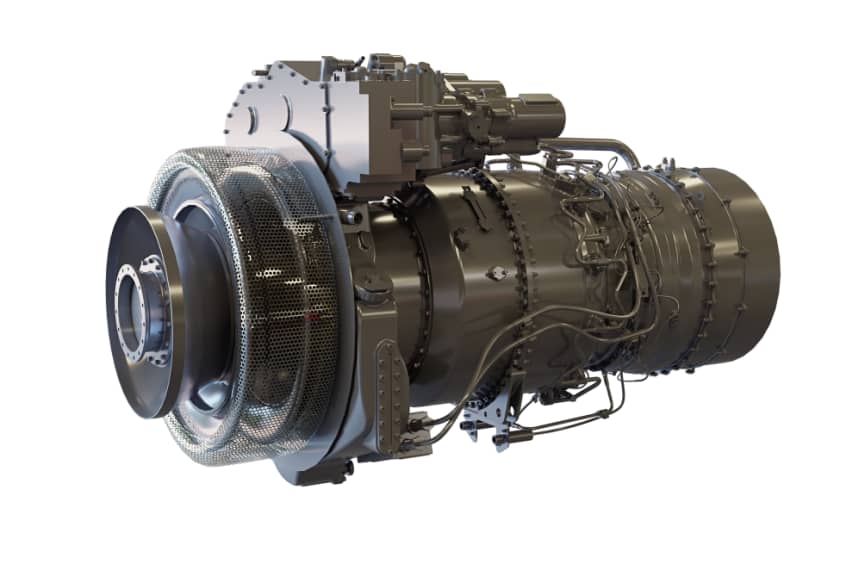
Hanwha Aerospace is embarking on the full-scale development of aircraft engines for unmanned aerial vehicles (UAVs), a core strategic asset for the future air battlefield, in collaboration with the Korea Aerospace Administration. Based on public-private cooperation, the company plans to contribute to national defence by developing a 4,500-pound (lbf) class UAV engine using domestic technology by 2029 that can also be expanded for civilian use. The goal is to actively target the global UAV and civilian jet engine markets. This marks the first time an aircraft engine has been domestically developed for both civilian and military dual-use applications. Hanwha Aerospace attended the "Joint Kick-off Meeting for the Development of Next-Generation Civil-Military Dual-Use Aircraft Engines and Propulsion Systems," hosted by the Korea Aerospace Administration (KASA), held on the 26th at the KASA headquarters in Sacheon, Gyeongsangnam-do. The meeting, presided over by Han Chang-heon, Head of the Aerospace Innovation Division at KASA, was attended by the Korea Aerospace Research Institute (KARI), a subsidiary of KASA, as well as participating universities and companies, to engage in in-depth discussions on the project's direction and cooperation strategies.
Optimised CCA through High-Capacity Power Supply… High Fuel Efficiency Enables Expansion to Civil Aircraft
This project is a national collaborative initiative led by Hanwha Aerospace, involving the joint development of research institutes such as KARI, universities, and small but strong companies.
With a target completion date of 2029, this engine is the first in Korea to mount the starter generator directly on the engine's rotating shaft rather than as an external unit. Its key advantage is its ability to stably supply up to 100kW of power. It offers higher electrical output than comparable engines and is relatively lighter overall due to its integrated generator.
In particular, it can be described as an engine optimised for unmanned aerial vehicles (UAVs) that require significant power. For instance, Collaborative Combat Aircraft (CCA), which perform various missions alongside manned fighter jets, require a large amount of power not only for AI-based operational computations but also for radar, electronic warfare, and sensor operation; therefore, the engine's power generation capability is a core technological element. Just like electric vehicles, the increasing use of electrical equipment in aircraft (electrification) is a current trend in aviation.
This engine is scheduled to be developed as a "high-bypass" turbofan engine with dual-use civilian and military applications in mind. Designed to optimise airflow within the engine for high fuel efficiency, it is expected to be applicable to various civilian aircraft, such as small business jets, in the future.
'Development Speed and Cost-effectiveness are Key': Targeting the Global UAV Market with Innovative Manufacturing Technology
Handwha Aerospace's strategy is to take the lead in the global UAV market, starting with CCA engines based on its 4,500-pound class engines. Industry experts predict that as the adoption of CCA engines accelerates, centred in the United States, more than 3,000 units will be in operation worldwide by the 2040s.
Amidst recent instability in the international political landscape of the Middle East and Eastern Europe, "rapid development speed" and "cost-effectiveness" are emerging as key competitive advantages in the global defence market. Hanwha Aerospace plans to secure competitiveness in the global UAV engine market by developing lightweight and electrified engines that reduce development time and costs through the utilisation of advanced manufacturing technologies, such as 3D printing and composite materials possessing both heat resistance and lightness.
Furthermore, the revitalisation of UAV engine exports is expected to lead to the expansion of the entire domestic aerospace ecosystem, contributing to the creation of high-quality jobs and the revitalisation of the regional and national economies. Hanwha Aerospace is developing various unmanned aerial vehicle (UAV) engines using domestic technology in collaboration with the government, including this 4,500-pound class turbofan engine, a 5,500-pound class low-bypass turbofan engine focused on high manoeuvrability for "low-observable UAV squadrons," and a 1,400-horsepower turboprop engine for "medium-altitude unmanned aerial vehicles (MUAVs)." The company is also participating in the development of core technologies for a 10,000-pound turbofan engine for "stealth UAVs." Hanwha Aerospace has announced plans to invest 750 billion won in the development of UAV systems and engines, as well as the establishment of testing and mass production facilities.
Han Chang-heon, Head of the Aviation Innovation Division at the Korea Aerospace Administration, stated, "High-bypass turbofan engines are strategic technologies that will determine core competitiveness in the next-generation aviation sector." He added, "We will do our utmost to manage the project to consolidate domestic capabilities, internalise core technologies, and secure leadership in the global market." Park Hee-ho, CTO of Hanwha Aerospace's Aerospace Business Division, stated, "As the global UAV engine market is still in its early stages with an unsolidified landscape, we will do our utmost to secure technology proactively to not only contribute to strengthening the Republic of Korea's UAV capabilities but also to leap forward as a leading company in the global market."
| Contact details from our directory: | |
| Korea Aerospace Research Institute (KARI) | Airframer |
| Hanwha Aerospace | Piston Diesel Engines, Turbofan Engines, Turboshaft Engines, Electric Engines, Fuel Cells, Turboprop Engines |
| Related directory sectors: |
| Turbine Engines |

Weekly news by email:
See the latest Bulletin, and sign up free‑of‑charge for future editions.
HAL and Safran finalise Aravalli engine deal
JetZero raises $100m as Z4 nears flight test
Bombardier acquires MHI Canada Aerospace assets