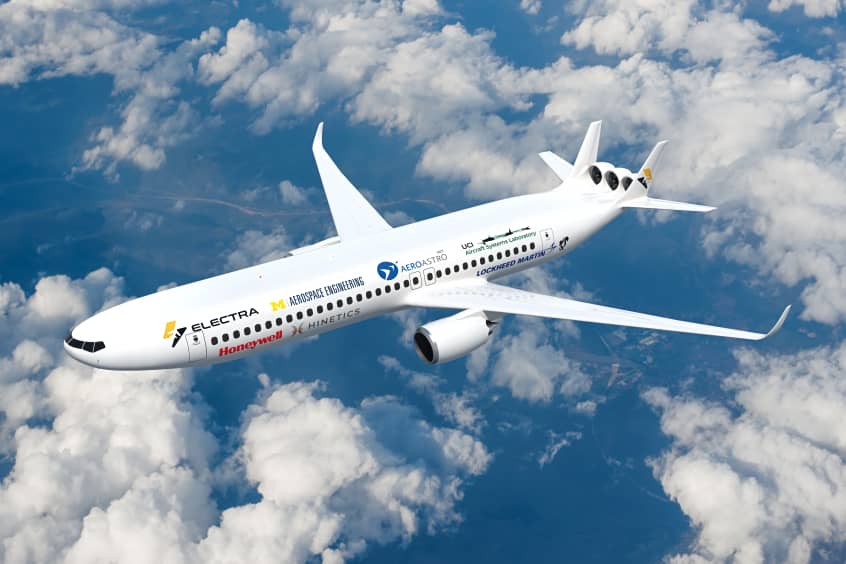
Photo: Electra.aero
The concept combines a lifting fuselage with electrically powered boundary layer ingesting tail fans.
Electra has unveiled a conceptual airliner design developed through NASA's Advanced Aircraft Concepts for Environmental Sustainability (AACES) 2050 programme, exploring how electrification and integrated aircraft design could reshape commercial aviation by mid-century.
The study focuses on aircraft carrying more than 100 passengers and investigates how targeted electrification, advanced aerodynamics and closer integration between airframe and propulsion systems could improve efficiency beyond gains already expected from future engine and structural technologies.
At the centre of the concept is a double-bubble fuselage that contributes additional lift while electric tail-mounted fans ingest and re-energise slower-moving airflow over the aircraft. Electricity for the fans is generated by two underwing turbofan engines, creating a hybrid-electric architecture intended to improve overall aircraft performance.
Electra's analysis suggests the configuration could provide up to a 17% efficiency improvement beyond advances anticipated by 2050 through conventional technology developments alone.
“The value of electrification in this concept is that it lets us put the propulsion where it couldn't go before but does the most good,” says Dr. Parker Vascik, Director of Product Strategy at Electra. “We can radically improve how the airframe and propulsion system work together while keeping the aircraft grounded in real airline and airport operations. The goal is not just efficiency on paper, but concepts that we can actually build, certify, and use.”
The aircraft has been designed to fit existing airport gates and operational requirements while using conventional jet fuel or sustainable aviation fuel. Electra says the configuration would not depend on airport charging infrastructure or alternative fuel systems that have yet to be proven at scale.
The design also incorporates a twin-aisle cabin within a narrowbody aircraft category, offering the potential for improved passenger comfort and more efficient boarding and deplaning.
The programme was led by Dr. Alejandra Uranga, Electra's Chief Engineer for Research and Future Concepts, whose previous work included NASA-sponsored research at MIT that helped advance the original double-bubble and D8 aircraft concepts.
Alongside the aircraft study, Electra produced 11 technical papers and adopted NASA's open-source Aviary multidisciplinary design and optimisation tool, while also developing an electrified aircraft design suite intended for public use.
| Contact details from our directory: | |
| Electra.aero | Airframer |
| Massachusetts Institute of Technology - MIT | Academic Institutions, Automatic Flight Control Systems |
| Honeywell Aerospace | Air Conditioning Equipment, Air Conditioning Equipment, Air Data Computers, Air Purification Systems, Airborne Communication Systems, Airspeed Indicators, Angle of Attack Indicators, Attitude and Heading Reference Systems, Automatic Direction Finders, Automatic Flight Control Systems, Autopilots, Avionics Management Systems, Bleed Air Systems, Cabin Management Systems, Cabin Pressure Control Systems, Cargo Systems, Cockpit Control Systems, Cockpit Printers, Cockpit Video Displays, Collision Avoidance Systems/TCAS, Cooling Systems, Distance Measuring Equipment, Electric Power Controllers, Electromagnetic Test Services, Electronic Flight Instrument Systems, Emergency Locator Transmitters, Engine Parts, Enhanced Vision Systems (EVS), Environmental Testing Services, Fibre Optic Gyroscopes, Flight Management Systems, Flight Recorders, Fly-by-Wire Systems, Fuel Tanks & Systems, Glide Slope Receivers, GPS, Heading Indicators, Horizontal Situation Indicator, IFF Interrogators, Inertial Components & Systems, Inflight Entertainment, LCD Displays, Magnetometers, Moving Maps, Multi-Mode Receivers (MMR), Onboard Intercom Systems, Pneumatic Systems Equipment, Precoolers, Proximity Sensors, Radar Transponders, Radar/Radio Altimeters, Radio Communications Equipment, Starter Generators, Terrain Awareness and Warning Systems, Testing Services, Transceivers, VOR (Omnirange) Receivers, WAAS Equipment, Weapons Countermeasures, Weather Mapping Radar |
| Lockheed Martin Skunk Works | Airframer |
| University of Michigan Aerospace Engineering | Technical/Eng/Scientific Studies |
| Related aircraft programs: |
| Electra.aero eSTOL |
| Related directory sectors: |
| Design |

Weekly news by email:
See the latest Bulletin, and sign up free‑of‑charge for future editions.
HAL and Safran finalise Aravalli engine deal
JetZero raises $100m as Z4 nears flight test
Bombardier acquires MHI Canada Aerospace assets